
The Dirty Secret About Onboarding
One pattern repeats across organizations of every size: everyone assumes someone else owns the onboarding follow-through.
IT assumes HR owns it. HR assumes the hiring manager owns it. The hiring manager assumes the process is automated. Meanwhile, a new engineer arrives on day one without a laptop, without system access, and without anyone prepared to brief them on what to do.
The pattern is consistent. A candidate signs an offer letter. Recruiting celebrates the close and moves on to the next search. The paperwork lands in HR’s inbox, and no single function is tracking whether it moves forward. Three weeks later, the new hire still does not have access to the systems they need. The hiring manager was never briefed. IT provisioning happened, but no one coordinated with facilities about a desk. The manager assumed HR was handling it. HR assumed the manager was handling it. The new employee’s first week has already been compromised.
Onboarding is consistently the most broken workflow in HR. This guide explains why, and what AI Teammates do about it.
What Is AI for Employee Onboarding?
The term “AI onboarding software” encompasses a range of products with very different capabilities. It is worth defining clearly what AI Teammates for onboarding actually are.
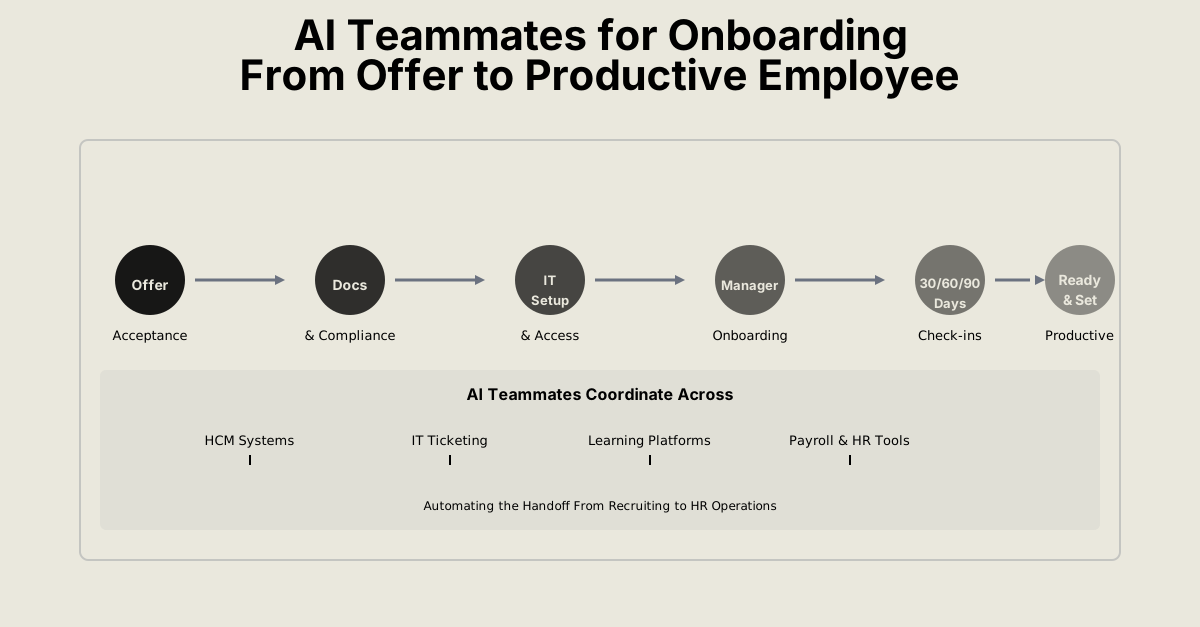
AI Teammates for onboarding are autonomous systems that execute the full employee onboarding workflow from offer acceptance through to productive employee. They coordinate across HR, IT, the hiring manager, and the new hire without requiring a human to chase every handoff or escalation. They reason through exceptions, they adapt when things do not go to plan, and they own the entire journey.
This is not a checklist tool or an email sequence. It is an active AI Teammate that moves through the onboarding process, triggering actions in the HCM, IT service management system, learning management system, and payroll platform, and handling the coordination that would otherwise fall through the cracks.
Instead of HR building a workflow that assumes everything will go smoothly, an AI Teammate handles the parts that do not.
Why Onboarding Is the Most Broken Workflow in HR
Onboarding spans multiple teams. Recruiting owns the offer. HR Operations owns the administrative setup. IT owns systems and access. The hiring manager owns work integration. Facilities manages physical infrastructure where applicable. L&D owns compliance training. Payroll needs everything in place before the first pay cycle.
Onboarding spans multiple systems. The HCM system holds the employee record. IT ticketing handles provisioning requests. The LMS holds compliance training and role-specific courses. Payroll has its own system. Access management may run on a separate platform. These systems do not communicate natively.
Onboarding is all handoffs. From recruiting to HR. From HR to IT. From IT to the manager. From the manager to L&D. And every single handoff is a place where things get dropped.
The core problem is that no single function owns the end-to-end process. Recruiting cares about hiring. HR Operations cares about getting the paperwork done. IT cares about provisioning. The hiring manager cares about having a productive team member. But no single person’s role is to ensure that all of those things happen in the right order and without delays.
The result is new hires who do not have laptop access on day one. Employees who never complete their onboarding training. Hiring managers who are chasing HR for updates. New employees who feel lost and unsupported in their first weeks. And HR operations teams overwhelmed managing a process that should be routine.
Onboarding coordinators commonly report spending 30, 40, or even 50 percent of their week chasing completion of tasks that should be automated. It is not strategic work. It is coordination work that a system should handle.
What AI Teammates Do in Onboarding
The following section describes the specific workflows that an AI Teammate handles, organized by the life cycle of a new employee.
Pre-Boarding: Offer to Day One
Once the offer is signed, the AI Teammate takes over.
It automatically triggers a documentation request: I-9 forms, emergency contact information, benefits elections, and any compliance or background check requirements. Rather than sending a generic email and waiting for completion, the AI Teammate follows up, tracks progress, escalates if needed, and confirms completion before the hire date.
The AI Teammate coordinates IT provisioning by submitting tickets to create email accounts, provision hardware, set up access to required systems, and configure third-party tools. It tracks whether those tickets have been completed and escalates if hardware will not arrive by the hire date.
It schedules orientation activities and sends welcome materials to the new hire. Onboarding flows, office tours, and team introductions are coordinated and confirmed. The new employee knows exactly when to show up and what to expect.
It briefs the hiring manager. The AI Teammate sends the manager an introduction to the new hire, confirms their availability for day-one check-ins, and prepares them with the new hire’s background and any role-specific context.
Day One and Week One: Setting Up for Success
On day one, the AI Teammate confirms that all foundational access is in place. Can the new hire log in? Can they access their email, team systems, and role-specific tools? If anything is missing, the AI Teammate flags it immediately and escalates to IT.
It facilitates the manager’s first check-in, sends a check-in template, confirms that the manager has covered the key topics, and follows up with the new hire to identify any blockers.
It confirms training enrollment. Compliance training, role-specific onboarding, and company culture courses are tracked by the AI Teammate. Reminders are sent if progress falls behind schedule.
It resolves blockers. If something is not working or the new hire is unclear on a process, the AI Teammate collects information, escalates to the appropriate team, and follows up until the issue is resolved.
30/60/90 Days: Tracking Progress and Milestones
Onboarding does not end on day one. It extends through the critical first 90 days.
The AI Teammate runs automated check-ins at 30, 60, and 90 days. It asks the manager how the new employee is progressing. It checks in with the new hire about their experience, their confidence, and any blockers they are facing. It tracks whether expected milestones have been hit.
It escalates issues. If the 30-day check-in reveals that the new hire is struggling, the AI Teammate escalates to HR or the manager for intervention. There may be a skill gap that needs training, a cultural misalignment that needs addressing, or a technical blocker that needs IT support. The AI Teammate does not just surface the issue. It ensures the right person is handling it.
Probation periods, benefits enrollment windows, and tax withholding confirmations are tracked by the AI Teammate to ensure nothing is missed.
Cross-System Coordination: Making Systems Talk
The AI Teammate works across the HCM, IT ticketing system, LMS, and payroll platform. It reads from each system. It writes to each system. It sequences actions across systems, for example not running the 30-day check-in until the HR system confirms the employee has been officially onboarded and added to payroll.
It bridges the gap between recruiting systems and HR Operations systems. Most organizations run recruiting in one platform and HR Operations in another, across combinations of Dayforce, iCIMS, UKG, and Workday. The handoff between those systems is a common failure point. An AI Teammate coordinates across both, ensuring the employee record is properly transferred and no information is lost.
It handles exceptions without stopping. The standard path is: offer accepted, paperwork, IT provisioning, manager onboarding, productive. But onboarding is full of exceptions. The laptop does not arrive on time. A background check takes longer than expected. The hiring manager is on leave. The new hire needs an accommodation. Traditional workflow automation stops when it encounters an exception. An AI Teammate reasons through the exception, explores options, escalates for human approval when needed, and keeps the process moving.
Onboarding Is Where Recruiting Meets HR Operations
Onboarding is the handoff point between recruiting and HR Operations, and it is consistently underserved.
Recruiting’s role is to attract, evaluate, and hire the right candidates. HR Operations’ role is to set up the infrastructure for those employees to be productive and supported. These are different functions, different priorities, and sometimes different systems.
The recruiting team celebrates the hire and moves on to the next candidate. HR Operations inherits an employee record and a coordination list spanning multiple teams and systems. There is no natural mechanism for coordination between recruiting and HR Operations. No function explicitly owns the transition. The new hire, who has just accepted the role, gets caught in the gap.
AI Teammates bridge this gap by working across both recruiting systems and HR Operations systems. They own the entire journey from signed offer through to productive employee. They coordinate both the recruiting handoff and the HR Operations execution. The moment recruiting’s role is complete, HR Operations is ready to take over, on schedule.
The differentiation is not automating HR’s internal workflow. It is automating the handoff between recruiting and HR. That is where most onboarding programmes fail.
Why Onboarding Automation Is Not Enough
Traditional onboarding automation has a ceiling.
Workflow tools and email sequences work well for the expected path. A trigger is configured and a series of actions follow: send paperwork request, schedule orientation, create IT ticket, notify the manager. If everything goes smoothly, the result is significant manual work savings. For some organizations, that is sufficient.
But onboarding is full of exceptions. The talent acquisition system and the HCM system do not sync properly, so the employee record does not transfer. The laptop order is delayed and will not arrive on day one. The I-9 form does not get completed because the candidate missed an email and intended to handle it later. The hiring manager is on parental leave and never received the onboarding brief. The new hire’s background check is pending, so building access cannot be granted yet.
Traditional onboarding automation stops at every one of these exceptions. It is built on the assumption that things will proceed as planned. When they do not proceed as planned, human intervention is required.
An AI Teammate does not stop at exceptions. It reasons through them. When a laptop is delayed, the AI Teammate considers mitigation options: remote work for the first week, a loaner device, or escalating the hardware order. It handles the contextual decisions that arise in real onboarding scenarios.
That is the difference between automation and agentic AI. Automation is a sequence of predetermined steps. An AI Teammate is a reasoning system that navigates the actual complexity of bringing a new employee into an organization.
The Business Impact of Better Onboarding
Faster time to productivity. New hires who have access to systems on day one, who have been properly briefed by their managers, who understand their role and the company culture, are productive faster. They are not spending the first two weeks waiting for setup or figuring out how things work. Even one week less in ramp-up time represents meaningful productivity gains across the organization.
Reduced early attrition. A significant portion of new hire turnover happens in the first 90 days. Much of that is driven by a poor onboarding experience. New employees who feel lost, unsupported, or unclear about their role are more likely to leave. Better onboarding, where they feel welcomed, set up for success, and integrated with their team, reduces that attrition.
Lower compliance risk. Onboarding workflows often fail to complete key compliance steps: I-9 verification, background check confirmation, required training completion, tax withholding setup. These failures create audit risk and legal exposure. An AI Teammate ensures these milestones are not missed.
Hiring manager satisfaction. Managers who spend hours chasing HR for onboarding updates are frustrated managers. Managers who have a new hire show up on day one ready to work are satisfied managers. That matters for retention of top managers and for their ability to focus on their actual responsibilities.
HR team capacity. Onboarding coordinators typically spend 40 to 50 percent of their week on coordination tasks that do not require human judgment. AI Teammates redirect that capacity to strategic HR work, employee development, and relationship building.
The business case is not confined to one of these areas. It is the compounding effect across all of them.
How to Get Started with AI Teammates for Onboarding
AI Teammates work within existing systems. There is no need to replace the HR tech stack.
If the recruiting platform is Dayforce, iCIMS, UKG, or Workday, and HR Operations runs in the same platform or a different one, an AI Teammate coordinates across those systems. If a dedicated HR ticketing system or IT service management platform is in use, the AI Teammate integrates there. If an LMS handles compliance training, the AI Teammate manages enrollment and progress tracking.
Implementation is straightforward: configure the AI Teammate with the onboarding workflow, integrate with existing systems, and deploy. It begins managing the handoff from recruiting to HR Operations immediately. Results are visible within the first 30 to 60 days as new hires onboard with fewer delays, fewer follow-ups, and better experiences.
The team that owns onboarding, usually HR Operations or People Operations, sees the impact first: fewer manual tasks, fewer escalations, and fewer new hires arriving without proper setup. From there, the benefits extend to hiring managers, to new employees, and to the organization’s overall performance.
Frequently Asked Questions
Q: What is AI for employee onboarding?
A: AI for employee onboarding refers to autonomous AI systems, such as AI Teammates, that manage the entire onboarding workflow from offer acceptance through to productive employee. Unlike traditional onboarding automation, which runs predetermined sequences, AI Teammates actively coordinate across multiple teams and systems, reason through exceptions, and ensure nothing is missed.
Q: How do AI Teammates handle onboarding across multiple systems?
A: AI Teammates integrate with the existing HR tech stack. Whether recruiting runs in Dayforce, iCIMS, UKG, or Workday, and HR Operations runs in a dedicated HCM or a different platform, the AI Teammate reads from and writes to each system. It sequences actions across platforms and ensures data consistency across systems.
Q: Can AI Teammates coordinate with IT for new hire provisioning?
A: Yes. An AI Teammate integrates with the IT service management platform to submit, track, and escalate provisioning requests. It confirms when access has been granted, identifies blockers such as delayed hardware, and escalates issues to IT if something is at risk of not being completed by the hire date.
Q: What happens when something goes wrong during onboarding?
A: When an exception occurs, such as a delayed background check, hardware that will not arrive on time, or an unavailable hiring manager, an AI Teammate does not stop. It reasons through the exception, explores options, escalates to the right person for approval if needed, and keeps the onboarding process moving forward.
Q: Do AI Teammates replace the onboarding coordinator role?
A: No. AI Teammates handle the coordination tasks that onboarding coordinators spend 40 to 50 percent of their week on. Onboarding coordinators then focus on strategic HR work: employee development, relationship building, and complex case resolution. The role is not eliminated; it is elevated.
Q: How quickly can you deploy an AI Teammate for onboarding?
A: Deployment is fast. If the recruiting and HR platforms are already connected, an AI Teammate can be operational within 30 to 60 days. It begins managing onboarding for the next cohort of new hires immediately, and impact is visible in the first month as new hires experience fewer delays and better coordination.
Q: What is the difference between onboarding automation and an AI Teammate?
A: Onboarding automation runs predetermined sequences: if X happens, then Y follows. It is efficient for the expected path but stops at exceptions. An AI Teammate is a reasoning system that navigates the actual complexity of onboarding. It handles exceptions, coordinates across systems in real time, escalates intelligently, and adapts to context. Automation is helpful. An AI Teammate is transformative.
Ready to Own Your Onboarding Workflow?
AI Teammates are managing the onboarding journeys of new employees at forward-thinking organizations. To see how they handle the recruiting-to-operations handoff end to end, request a demo.
Related Reading
- Agentic AI for HR — Explore how AI Teammates transform the entire HR function, not just onboarding.
- AI Teammates for Recruiting: From Job Req to Signed Offer — Discover how AI Teammates manage talent acquisition and handoff cleanly to HR operations.
- Agentic AI for HR Operations: Beyond Automation — Learn how AI Teammates handle the full HR operations workflow.
- Amp Home — Discover AI Teammates for Digital Labor.