The HR Technology Execution Gap
The HR technology landscape has evolved rapidly over the past decade, shifting from on-premises platforms to sophisticated cloud-based systems of record. Throughout this evolution, artificial intelligence in HR has progressed from simple chatbots answering frequently asked questions to large language models that can reason across complex business contexts. The most consequential shift, however, is not happening within the systems of record themselves. It is happening in the execution layer that sits above them.
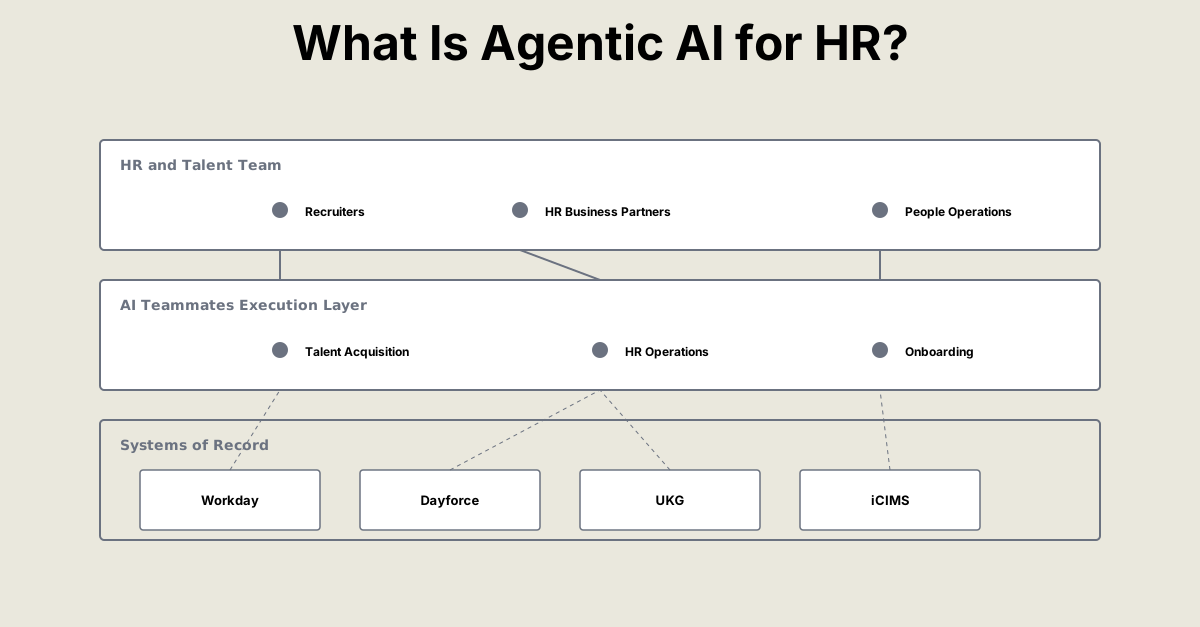
This shift is the rise of agentic AI for HR. The systems of record, including Dayforce, iCIMS, UKG, and Workday, have become incredibly sophisticated at storing, organizing, and reporting on human capital data. What they have not done is evolve to autonomously execute the multi-step workflows that HR and Talent teams manage every single day. That execution layer is now being filled by AI Teammates: autonomous AI systems purpose-built for human resources and talent operations that independently execute multi-step workflows from start to finish.
This guide covers everything needed to understand agentic AI for HR, how it differs from earlier generations of HR technology, what it can accomplish, and why it matters for your organization.
What Is Agentic AI for HR?
To understand agentic AI for HR, it is necessary to first define what “agentic” means in the context of artificial intelligence. Agentic does not simply mean the use of artificial intelligence. It does not mean applying a large language model to a problem. Instead, agentic AI describes autonomous systems that receive a goal or objective, reason about the steps required to achieve it, take independent action across systems without human intervention, observe the results of those actions, and adapt their approach based on feedback.
Agentic AI for HR is defined as autonomous AI systems purpose-built for human resources and talent operations that independently execute multi-step workflows from start to finish. These systems operate across the boundaries of traditional HR systems of record, orchestrating work across Dayforce, iCIMS, UKG, Workday, and other platforms without requiring human hands on keyboard between each step.
The critical word here is “autonomously.” A chatbot that suggests an answer to an employee question is not agentic. A copilot that prompts a recruiter to take action is not agentic. An agentic AI system for HR receives a directive, whether it is to schedule a candidate interview, onboard a new hire, or process a leave request, and executes that directive end to end, making decisions along the way, handling exceptions, and reporting results back to the HR team.
Agentic AI for HR operates on three foundational principles. First, it reasons about workflows. Rather than following rigid, hard-coded rules, agentic AI understands the nuances of HR work and can adapt its approach based on context. Second, it acts autonomously. It does not wait for human permission or confirmation between steps. It executes. Third, it operates across systems. It does not live within a single platform. It coordinates work across the entire HR technology stack, treating each system of record as a data source or execution target.
This is fundamentally different from the chatbots and copilots that dominated the conversation around AI in HR until recently. Those technologies ask questions or suggest actions. Agentic AI for HR takes action and reports back.
The Evolution of AI in HR: From Chatbots to AI Teammates
The conversation around AI in HR has evolved through three distinct generations. Understanding this progression is essential to recognizing why agentic AI for HR represents a genuine shift in capability rather than an incremental improvement.
The first generation was chatbots. These systems emerged in the early 2010s as rule-based or lightly intelligent assistants designed to deflect simple questions and requests away from the HR team. They could answer frequently asked questions about benefits, vacation policies, or payroll. They could direct employees to self-service portals. They were effective at reducing the volume of straightforward inbound requests to the HR team. However, chatbots operated entirely within the boundaries of the question-and-answer paradigm. They did not execute work. They provided information or directed the human to where they might find answers. Chatbots succeeded by deflecting work away from HR, not by actually performing that work.
The second generation was copilots. As large language models became more sophisticated, HR technology vendors introduced copilot functionality. Copilots acknowledged that AI could do more than answer questions. They could suggest actions to human workers. A recruiter could ask a copilot to review a job description and receive feedback. An HR Business Partner could ask a copilot to draft an employee relations response. A manager could ask a copilot to suggest interview questions. Copilots promised to augment human decision-making by offering AI-generated suggestions that a human would then review, approve, and act upon. The human remained in control. The AI suggested. This represented a meaningful step forward from chatbots, but copilots still operated in a fundamentally human-centric model where the human reviewed, approved, and executed.
The third generation is agentic AI, represented by AI Teammates. Rather than suggesting, AI Teammates execute. Rather than waiting for human permission, they act autonomously according to governance frameworks and policies set by the organization. Rather than operating within a single system, they orchestrate work across the entire HR technology stack. AI Teammates represent a shift from “AI assists humans” to “AI performs work alongside humans.”
Systems of record provide the foundation of accurate, governed data. Above them, the AI Teammates execution layer orchestrates multi-step workflows across these platforms. Above that sits the HR and Talent team, now focused on strategy, relationship-building, and human judgment rather than routine transactional work.
What AI Teammates Do: Core Capabilities
Amp’s AI Teammates address three primary verticals where agentic AI for HR delivers the most significant impact: Talent Acquisition, HR Operations, and Onboarding. Within each, AI Teammates can independently execute complex, multi-step workflows that would otherwise require significant human effort.
Talent Acquisition is the first vertical. In recruitment, agentic AI for HR can autonomously screen resumes against job specifications, ranking candidates and identifying the strongest profiles without human involvement. It can schedule interviews by negotiating availability across the recruiter, the candidate, and the hiring manager, automatically updating calendars and sending confirmations. It can coordinate the entire interview process, collecting feedback from all participants, synthesising that feedback, and advancing candidates through pipeline stages based on predefined criteria. Rather than a recruiter spending six hours a day managing scheduling and pipeline administration, those tasks become the domain of AI Teammates, freeing the recruiter to focus on relationship-building, negotiation, and strategic hiring decisions. For more detail on how agentic AI transforms recruitment, please refer to the dedicated guide on agentic AI for recruiting.
HR Operations is the second vertical. Here, agentic AI for HR takes on the complex, labor-intensive case management and workflow orchestration that consumes a significant portion of HR Business Partner time. An AI Teammate can receive a leave request, verify eligibility against company policy and applicable employment law, check accrual balances across multiple jurisdictions, route the request for appropriate approval, execute the calendar block in the employee’s scheduling system, and notify payroll of the absence window, all without human intervention. Similarly, agentic AI can manage policy questions by understanding the nuances of company policy, checking employee eligibility, identifying exceptions, and providing compliant, contextual guidance. It can execute data corrections and compliance workflows across multiple systems, handle policy enforcement at scale, and escalate genuinely novel situations to a human for judgment. The result is that HR Operations teams can focus on exception-handling and strategic compliance initiatives rather than routine case processing. For comprehensive guidance on HR operations capabilities, please see the complete guide to agentic AI for HR operations.
Onboarding is the third vertical. The onboarding journey is inherently multi-step and multi-system. An AI Teammate receives an offer acceptance, confirms the start date, routes the employee data through identity verification, provisions accounts across all company systems, coordinates IT equipment delivery, generates and collects signature-required documents, enrolls the employee in benefits, and sends on-the-day logistics information to the new hire and their manager. This entire workflow, which typically involves manual coordination across HR systems, IT ticketing systems, benefits platforms, and email, can be orchestrated end-to-end by agentic AI. The result is that new employees are productive on day one because their technical infrastructure, access, and documentation are all complete before they arrive. For more information on how AI Teammates transform the onboarding experience, please see the guide to AI Teammates for onboarding.
These three verticals, Talent Acquisition, HR Operations, and Onboarding, represent the primary domains where agentic AI for HR has matured to the point of delivering measurable business impact. Each requires autonomous workflow execution across multiple systems, each involves complex decision-making and policy application, and each represents significant time investment for HR teams when managed manually.
Agentic AI for HR vs. Copilots, Chatbots, and RPA
A natural question arises: how does agentic AI for HR differ from copilots, chatbots, and other automation technologies that have already been deployed in HR systems? The answer lies in the level of autonomy, the breadth of scope, and the accountability for outcomes.
A chatbot answers questions or deflects work. A copilot suggests actions that a human must review and approve. A robotic process automation platform automates individual, repetitive tasks according to hard-coded rules. Each has a role, and each is useful within narrow boundaries. However, none of these technologies take autonomous action to complete a business objective.
Agentic AI for HR differs fundamentally in its operating model. An AI Teammate receives a business objective, whether it is to process a leave request, schedule interviews, or onboard an employee, and autonomously executes the necessary steps to completion. Where a copilot would suggest that a recruiter check the leave policy and then route the request to the manager, an AI Teammate checks the policy, verifies eligibility, routes to the manager, waits for approval, processes the absence, and notifies payroll, all without human intervention.
Robotic process automation systems can automate individual steps within a workflow, but they operate within a single system and follow deterministic, pre-programmed logic. RPA cannot handle nuance, exception-handling, or the kind of cross-system orchestration that modern HR work demands. An RPA bot might automatically create an employee record in Workday based on a new hire form, but it cannot orchestrate the entire onboarding journey because it lacks the reasoning capability to handle exceptions and the multi-system awareness to coordinate across platforms.
Copilots operate in a different mode entirely. They are designed to augment human decision-making, not replace human execution. A copilot can review a job description and suggest improvements. It cannot autonomously revise the description, publish it to job boards, configure screening criteria, and begin reviewing applications. The human must review the copilot suggestion, approve it, and execute it.
Agentic AI for HR bridges these gaps. It combines the reasoning capabilities of large language models with governance frameworks that allow it to act autonomously within defined boundaries. It operates across system boundaries, treating multiple platforms as a coordinated whole. And it owns the outcome. When an AI Teammate schedules an interview, that interview is scheduled. When it onboards an employee, that employee has access, documents, and equipment ready on day one. The accountability for completion rests with the AI, not with a human who forgot to follow up.
For a more detailed comparison of agentic AI and copilot approaches, please refer to the dedicated blog post on agentic AI versus copilots for HR.
Why Systems of Record Need an Execution Layer
The HR technology landscape is dominated by powerful, purpose-built systems of record. Dayforce, iCIMS, UKG, and Workday are each the product of decades of development, significant investment, and deep expertise in their respective domains. Dayforce specializes in payroll and workforce management. iCIMS is purpose-built for talent acquisition. UKG leads in workforce scheduling. Workday excels at financial and people data management. Each system of record is designed to be the source of truth for specific categories of HR data and decisions.
However, none of these systems of record was designed to be a system of execution. They are not designed to autonomously orchestrate multi-step workflows that span across systems. When a new employee is hired through iCIMS and needs to be onboarded across Workday, their UKG schedule, and various IT systems, there is no built-in mechanism for that orchestration to happen automatically. It requires human coordination. When a leave request needs to be processed, it must navigate from one system to another with human involvement at each step.
Some system of record vendors have begun to develop their own agentic AI capabilities. Each vendor’s agentic capabilities operate within the boundaries of their own platform. An AI capability built into Workday excels at coordinating Workday workflows, but it cannot reach across to iCIMS to retrieve candidate data or to UKG to coordinate scheduling. It cannot orchestrate work across the entire HR technology stack because it was not architected to do so.
This is where the execution layer becomes essential. Agentic AI for HR that operates as a cross-platform execution layer can sit on top of existing systems of record and orchestrate work across all of them. It does not replace your systems of record. It depends on them. It reads data from them, writes data to them, and treats them as the systems of record they are designed to be. But it adds a layer of autonomous execution that none of the individual systems of record can provide alone.
The execution layer model is not a criticism of system of record vendors. On the contrary, it is a recognition of their strength. They do one thing exceptionally well: they are excellent systems of record. The execution layer is built precisely because that expertise is so focused. Agentic AI for HR in the execution layer model complements systems of record by adding autonomous, cross-system orchestration that allows HR and Talent teams to manage work at a scale and speed that were previously impossible.
The Trust and Governance Foundation
The introduction of autonomous AI into HR decision-making requires a fundamental rethinking of how organizations build trust in AI systems. This is not theoretical. HR decisions have real consequences. When an AI system schedules an interview, a candidate’s career path may be affected. When an AI system processes a leave request or applies a company policy, an employee’s wellbeing is at stake. When an AI system coordinates onboarding, the new employee’s first experience of the organization is shaped by that system’s competence.
Amp’s founding team spent three years building AI governance frameworks specifically for HR systems, through a prior organization called FairNow. FairNow’s entire mission centerd on ensuring that artificial intelligence in human resources decisions was built with governance, explainability, and fairness at the foundation rather than as an afterthought. That work established a foundational principle: governance in AI for HR is not a compliance checkbox. It is a prerequisite for responsible deployment.
Effective governance for agentic AI in HR requires several components working in concert. First, there must be clear policies that define the boundaries within which the AI operates. An AI Teammate should know exactly what decisions it can make autonomously and when it must escalate to a human. An AI Teammate should know what exceptions warrant human judgment and how to recognize them. These policies must be explicit, tested, and continuously refined based on real-world outcomes.
Second, there must be transparency in how the AI reaches its decisions. When an AI Teammate declines a leave request, the HR team must understand why. When it schedules an interview, there should be visibility into the criteria it applied. This transparency is not just a matter of trust. It is essential for identifying and correcting biases or errors in the system.
Third, there must be auditability. Every decision an AI Teammate makes should be logged, traceable, and reviewable. This is not a heavy-handed approach. Rather, it is recognition that HR work is not only important to the organization, it is important to the individual employees whose lives are affected by HR decisions. Auditability ensures accountability.
Fourth, there must be human oversight. This is not the same as requiring human approval for every decision. Rather, it means that there are clear escalation paths for situations that fall outside the normal decision boundaries, and there are humans with clear responsibility for reviewing, testing, and continuously improving the AI system. Effective agentic AI for HR operates with significant autonomy, but that autonomy is paired with human oversight of the system’s overall performance and integrity.
Fifth, there must be mechanisms for continuous improvement. As the AI system encounters new scenarios, learns from outcomes, and experiences the consequences of its decisions, that learning must be captured, analyzed, and used to improve the system. The AI should become more capable, more nuanced, and more aligned with the organization’s values over time.
These governance elements are not optional add-ons to agentic AI for HR. They are foundational. An organization that deploys agentic AI for HR without a governance framework is taking on significant risk, both to its employees and to its own reputation and compliance posture. This is why agentic AI for HR, when done well, is built with governance from day one, not bolted on after deployment.
Digital Labor for HR: The C-Suite Perspective
The term “digital labor” may be new to many HR and Talent professionals, but it is rapidly becoming a critical concept in board-level and C-suite conversations about AI and workforce strategy. Digital labor refers to AI Teammates that are treated as a line item of organizational capacity, not as a software system.
When an organization buys enterprise software, it is purchasing a system. That system may be more or less effective, but the purchasing model and the way the organization thinks about it is fundamentally as a tool. The HR team uses the tool to perform work. Digital Labor operates on a different model. An AI Teammate that schedules interviews, onboards employees, or processes leave requests is not a tool in the traditional sense. It is a worker. It performs work. It has capacity. It can be assigned objectives. It has a cost per unit of work performed rather than a subscription fee for software access.
This distinction matters profoundly at the C-suite level. The Chief Human Resources Officer is increasingly being asked about workforce productivity, headcount optimization, and labor cost management. When Digital Labor is available, the CHRO can truthfully say that the organization is not increasing headcount while still increasing capacity. An additional AI Teammate that processes fifty leave requests per day is equivalent to additional FTE capacity in the leave processing function, but without the associated salary, benefits, and management overhead.
Gartner’s 2026 Chief Human Resources Officer priorities survey identified Digital Labor as an emerging strategic initiative for leading organizations. The survey noted that CHROs who are treating AI as a capacity layer rather than a software layer are seeing significantly better outcomes in automation, employee satisfaction, and strategic focus. This shift in framing from software to labor is not merely semantic. It changes how organizations budget for AI, how they evaluate ROI, and how they think about the role of AI in their workforce strategy.
Digital Labor also shifts the conversation about job displacement. Rather than framing AI as a threat to jobs, Digital Labor frames AI as additional capacity that allows human workers to focus on higher-value activities. A recruiter is not displaced by an AI Teammate that schedules interviews and manages pipeline administration. Rather, the recruiter is liberated from administrative work and can focus on building relationships with candidates, negotiating offers, and developing hiring strategy. An HR Business Partner is not threatened by an AI Teammate that processes leave requests. Rather, the HRBP can focus on employee development, strategic workforce planning, and complex employee relations situations that truly require human judgment.
This reframing is not only more accurate, it is more strategically compelling to boards and executives who are considering significant AI investments. Digital Labor provides a clear path to demonstrating ROI and competitive advantage without the employee morale and retention risks associated with narratives of job elimination.
How to Evaluate Agentic AI for HR
For an organization considering agentic AI for HR, the evaluation process must be rigorous and comprehensive. There are significant differences between solutions that claim to be agentic and solutions that are genuinely capable of autonomous, multi-step workflow execution. The following questions should guide the evaluation process.
First, does it execute or only suggest? This is the foundational question. Request a demonstration where the vendor shows the AI system autonomously completing a multi-step workflow without human intervention. Insist on seeing the full workflow from start to finish. A vendor that walks you through a copilot interface that suggests actions has not answered your question. An agentic AI for HR vendor should show you autonomous execution. If they cannot demonstrate this, you are looking at a copilot, not agentic AI.
Second, does it work across your systems of record, or only within a single platform? The power of agentic AI for HR lies in orchestration across system boundaries. Ask specifically how their system handles workflows that require coordinating across multiple platforms. Ask them to show a concrete example of a multi-system workflow and explain how their technology handles the coordination.
Third, is governance built into the system from the ground up, or is it an afterthought? Request documentation on how the system handles policy definition, decision logging, auditability, exception handling, and human escalation. A vendor that can articulate a clear governance model and show it functioning in their system demonstrates a fundamental understanding of why governance matters in AI for HR. A vendor that is vague about governance or that positions it as something that can be added later is taking shortcuts on something that matters.
Fourth, is the AI pre-trained on HR workflows, or does it require significant customization and configuration? There is a meaningful difference between agentic AI that comes with pre-trained understanding of common HR workflows and edge cases, and agentic AI that requires your organization to do significant machine learning work upfront. The former will deliver value faster and more reliably. The latter may be more customisable but will require more effort to deploy. Understand which model the vendor uses and assess whether it aligns with your organization’s technical resources and timeline.
Fifth, how is pricing structured, and does it align with consumption-based value? If agentic AI is genuinely delivering Digital Labor capacity, pricing should reflect that value. Rather than a fixed software subscription, pricing should be consumption-based or capacity-based. An AI Teammate that processes one hundred leave requests per month might cost ten percent of what an AI Teammate that processes five hundred requests costs. This pricing model aligns vendor incentives with organizational value. Beware of vendors that want to charge software licenses while delivering labor-like functionality. That misalignment of incentives is often a sign that the product is not as agentic or as capable as claimed.
The evaluation process for agentic AI for HR is more rigorous than evaluating traditional HR software, but this rigor is justified. You are evaluating systems that will make autonomous decisions affecting your employees. Taking time to understand their capabilities, governance, and limitations is essential.
The Future of Agentic AI for HR
The shift from copilots to AI Teammates represents the most consequential change in HR technology since organizations moved from on-premises systems to cloud-based platforms. That shift, which occurred across the 2010s, fundamentally changed how HR data was stored, accessed, and governed. The move to cloud platforms enabled real-time visibility into workforce data and enabled mobile and remote work at scale. It was transformative for the industry.
The shift to agentic AI is equally significant, but it operates at a different level. Where the move to cloud addressed the data layer, agentic AI addresses the execution layer. It is not about how data is stored or accessed. It is about what gets done with that data.
In the near term, over the next one to two years, agentic AI for HR adoption will accelerate among leading organizations. Vendors will continue to expand the breadth and depth of workflows that AI Teammates can autonomously execute. Systems of record vendors will likely develop deeper partnerships with agentic AI platforms, recognizing that their strength lies in being excellent systems of record, not necessarily in being excellent systems of execution. Organizations that embrace agentic AI will begin to see measurable improvements in time-to-hire, onboarding quality, leave processing speed, and HR team job satisfaction as administrative burden decreases.
In the medium term, over two to five years, agentic AI will become expected rather than exceptional. Leading organizations will have deployed AI Teammates in their Talent Acquisition, HR Operations, and Onboarding functions. The competitive advantage will shift from having agentic AI to having agentic AI that is deeply customized to organizational context and culture. The question will move from “Should we adopt agentic AI?” to “How much of our workforce capacity is supported by AI Teammates, and are we extracting maximum value from that capability?”
In the longer term, beyond five years, agentic AI for HR will likely expand beyond the three primary verticals to encompass learning and development, talent marketplace and mobility, workforce planning, and compensation management. The entire lifecycle of talent and people work will be increasingly supported by agentic AI, with humans focused on judgment, relationship-building, and strategy.
This evolution is not speculative. It is grounded in the trajectory of AI capabilities and the real business problems that agentic AI solves. HR is fundamentally important work. It affects people’s lives and careers. As agentic AI matures and proves itself capable of handling that work with appropriate governance and oversight, adoption will accelerate. The organizations that are early in that adoption journey will have built operational advantages that are difficult to replicate.
Frequently Asked Questions About Agentic AI for HR
What is agentic AI for HR?
Agentic AI for HR is defined as autonomous AI systems purpose-built for human resources and talent operations that independently execute multi-step workflows from start to finish. These systems operate across multiple HR platforms, reason about complex decisions, and complete work without requiring human approval between steps, though they operate within governance frameworks and policies set by the organization.
How is agentic AI different from a copilot in HR?
A copilot suggests actions that a human must review and approve. Agentic AI autonomously executes actions. A copilot might suggest that a recruiter schedule an interview. An agentic AI system schedules the interview by coordinating calendars, sending confirmations, and managing follow-up. Copilots augment human decision-making. Agentic AI performs work alongside humans.
What is the difference between agentic AI for HR and robotic process automation?
Robotic process automation automates individual, repetitive, hard-coded tasks within a single system using deterministic logic. Agentic AI for HR reasons about complex, multi-step workflows that span multiple systems, handles exceptions and nuance, and adapts its approach based on context. RPA cannot orchestrate across system boundaries. Agentic AI is designed specifically for cross-platform coordination.
Can agentic AI for HR work with my existing HR systems?
Yes. Agentic AI for HR is purpose-built to sit on top of existing systems of record like Dayforce, iCIMS, UKG, and Workday. It treats these platforms as sources of truth and execution targets, reading data from them and writing processed results back to them. It does not replace your systems of record. It complements them by adding a layer of autonomous, cross-system orchestration.
What HR workflows are best suited for agentic AI?
The three primary domains are Talent Acquisition (resume screening, interview scheduling, candidate coordination), HR Operations (leave request processing, policy application, case management), and Onboarding (offer-to-productive coordination, system provisioning, document collection). Each of these involves multi-step workflows that span multiple systems and would otherwise require significant human coordination.
How does agentic AI handle exceptions or complex scenarios?
Effective agentic AI for HR is designed with exception-handling and escalation pathways built in from the start. When an exception is detected, meaning something that falls outside the defined decision boundaries or that requires human judgment, the AI escalates the situation to a human with context and recommendations. This allows the AI to handle routine cases autonomously while ensuring that complex situations still receive human attention.
Is it safe to let AI make autonomous HR decisions?
Agentic AI for HR requires governance built in from day one. This includes clear policies defining decision boundaries, logging of all decisions for auditability, mechanisms for identifying and correcting bias, escalation pathways for exceptions, and continuous human oversight of system performance. When these governance elements are in place, agentic AI can safely make autonomous decisions within defined boundaries, much as a well-trained employee can make autonomous decisions within their role’s scope of authority.
What happens if an agentic AI system makes a mistake?
Every decision an AI Teammate makes should be logged and traceable. If a mistake is identified, the organization can review what happened, understand why the AI made that decision, correct the error, and adjust the system to prevent similar mistakes in future. This continuous improvement cycle is part of how agentic AI systems become more reliable over time. For genuinely consequential mistakes, human oversight mechanisms should catch issues before they affect large numbers of employees.
How is agentic AI for HR priced?
Pricing models for agentic AI should align with the labor-like value being delivered. Rather than software licenses, effective agentic AI is priced based on consumption or capacity. You might pay based on the number of candidates screened, the number of onboarding workflows completed, or the number of leave requests processed. This consumption-based pricing aligns vendor incentives with organizational value.
What is digital labor, and how does it relate to agentic AI for HR?
Digital Labor refers to AI Teammates treated as a capacity line item rather than a software line item. Where traditional software is licensed per system or per user, Digital Labor is thought of as workforce capacity. An AI Teammate that processes one hundred leave requests daily is equivalent to FTE capacity in the leave processing function, albeit without the salary, benefits, or management overhead of a human worker. This framing allows organizations to think about AI as a means of expanding capacity without proportional headcount growth.
Will agentic AI for HR eliminate jobs?
Agentic AI for HR does not eliminate jobs. Rather, it eliminates routine, administrative tasks within jobs. A recruiter is not eliminated by an AI Teammate that schedules interviews. The recruiter is freed from six hours per day of scheduling work and can focus on relationship-building, candidate development, and hiring strategy. An HR Business Partner is not eliminated by an AI Teammate that processes leave requests. The HRBP can focus on strategic workforce planning and complex employee relations work. The result is jobs that are more satisfying and organizations that are more strategic.
How do I get started evaluating agentic AI for HR?
Start with a clear assessment of which workflows consume the most time in your HR and Talent operations. Identify workflows that are multi-step, that span multiple systems, and that involve routine decision-making. These are prime candidates for agentic AI. Then, request demonstrations from vendors focused on autonomous, cross-platform execution. Ask them to show full end-to-end workflow execution without human intervention. Assess their governance framework. Understand their customization requirements. Most importantly, be skeptical of claims that exceed what you can observe in demonstration. Agentic AI for HR is real and transformative, but it is early, and differentiation between genuine agentic AI and more sophisticated copilots is important.
Next Steps: See AI Teammates in Action
The shift to agentic AI for HR is not theoretical. It is happening now, and forward-thinking organizations are beginning to see tangible benefits in hiring speed, onboarding quality, operational efficiency, and team job satisfaction.
To see agentic AI for HR in action, to understand how it works within specific systems and workflows, and to explore how AI Teammates fit into talent and people operations strategy, Amp is prepared to demonstrate. Amp’s founding team spent years building AI governance frameworks for HR and subsequently built the execution layer that allows those governance frameworks to be applied to real-world HR work.
To see agentic AI for HR in action and explore how AI Teammates fit into talent and people operations strategy, request a demo. Or read more on the Amp blog.