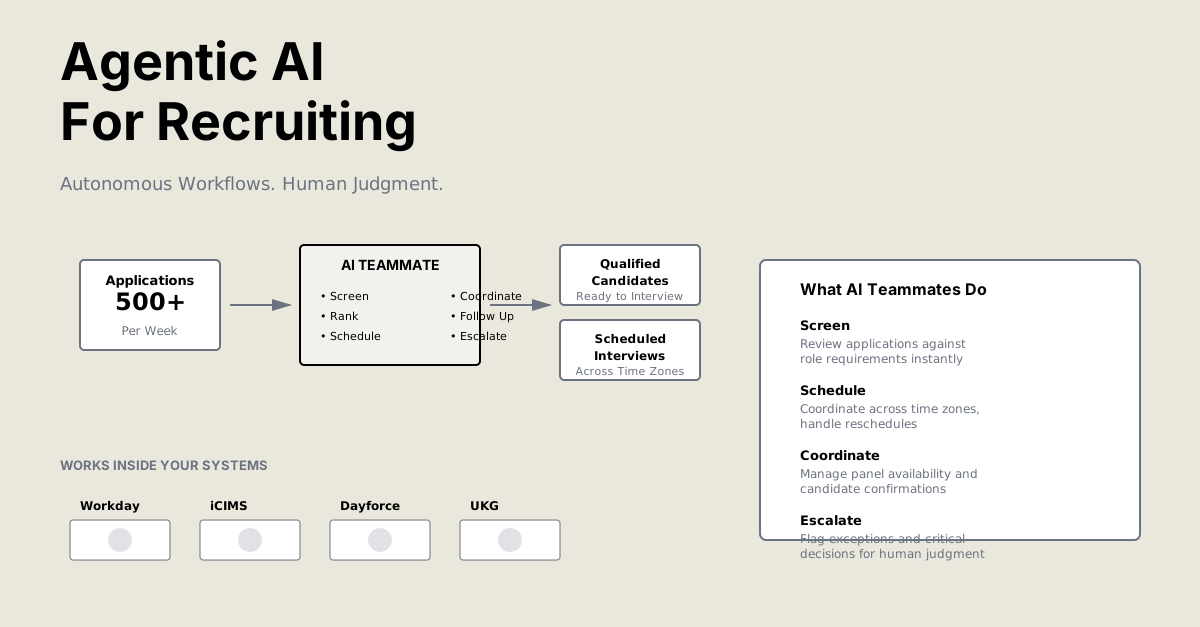
Agentic AI for Recruiting: The Complete Guide to AI Teammates for Talent Acquisition
Every Monday morning, recruiting teams at mid-market companies face the same reality: hundreds of new applications are waiting when they open their systems. By Tuesday, that number is higher. By Friday, it has grown again.
The challenge is not the complexity of individual tasks. It is the volume. Organizations that have invested in modern applicant tracking systems, recruiting coordinators, and automation flows built into their HCM platforms still find that volume overwhelms capacity. Every candidate response requires review. Every interview requires manual scheduling. Every panel requires availability coordination. Every rejection requires a follow-up to keep the talent pool warm.
Amp was founded by a team that built Ideal, one of the first platforms to apply AI to talent screening at enterprise scale. That experience surfaced a consistent finding across enterprise customers: sheer task volume, not speed per individual task, is the primary bottleneck in high-volume recruiting. An ATS manages data. A copilot accelerates one task at a time. Agentic AI executes the pipeline.
That is what this guide unpacks.
What Is Agentic AI for Recruiting?
Agentic AI for recruiting is a system that autonomously executes end-to-end recruiting workflows. It does not suggest actions or accelerate individual tasks. It does the work.
Screening applications against role requirements? An AI Teammate reviews, ranks, and progresses qualified candidates. Interview scheduling? It coordinates across time zones, handles reschedules, and confirms with candidates. Candidate communication, pipeline management, escalation to humans when judgment is required: AI Teammates handle it all without requiring a human in the loop for every step.
The key word is “autonomous.” This is not a copilot that makes recruiters faster. It is a Teammate that handles the volume.
Why Traditional Recruiting Tools Hit a Wall
The current state of recruiting technology presents three primary constraints.
ATSs manage data, not execution. An ATS stores candidate profiles, tracks pipeline stages, and logs notes. It is a system of record. But it does not execute anything without someone actively using it. Screening, scheduling, and messaging all require manual action.
Recruiting coordinators are human and finite. Recruiting coordinators are not going away, and that is not the goal. But the volume of tasks keeps growing while the number of coordinators stays flat. The choice becomes hiring more coordinators or automating the tasks they perform.
Copilots make you faster at one thing. A recruiting copilot might help write a better email or parse a resume more quickly. But it does not screen 500 candidates while the team is in another meeting. It does not schedule interviews while the recruiter is on a call. It does not follow up with candidates who have gone quiet. It is a speed multiplier, not a volume handler.
The bottleneck is not speed per task. It is the total number of tasks. A recruiter who screens twice as fast would still be overwhelmed by Tuesday.
Agentic AI addresses this because it does not get tired, does not need approval for every action (though it can escalate for critical decisions), and can execute workflows in parallel across the entire pipeline.
What AI Teammates Actually Do in Recruiting
The following sections describe the specific workflows AI Teammates handle.
1. Screening
An AI Teammate receives a new application and immediately reviews it against the role requirements: hard skills, soft skills, certifications, experience level, and location constraints. It compares the candidate’s profile against the defined rubric, assigns a qualification score, and makes a binary decision to progress or decline.
If the candidate qualifies, the AI Teammate can also:
- Rank the candidate against other applicants in the current cohort
- Extract key qualifications and flag unique strengths
- Suggest interview questions based on their profile
- Add tags for easy filtering later
Five hundred applications are processed in the time it would take a recruiter to review a handful.
2. Interview Scheduling
This is where most recruiting teams feel the most acute operational pain. An AI Teammate receives a qualified candidate and their availability. It checks panel availability across the entire interview team, for example a hiring manager in Toronto, a technical lead in Austin, and a culture fit interviewer working remotely. Time zones matter. Preferences matter. The AI Teammate coordinates across all of them and finds a slot that works.
If the first slot does not work, the AI Teammate does not escalate to a human to renegotiate. It tries the next option. It handles reschedules, sends confirmations, manages cancellations, and keeps the candidate informed throughout.
3. Candidate Communication
Status updates, confirmations, follow-ups, and rejections are sent by AI Teammates on time, every time. Not eventually. Immediately and consistently, in the candidate’s preferred language if configured.
This matters because candidate experience is recruiting brand. A candidate who receives a timely rejection and genuine feedback is more likely to apply again, refer others, or speak positively about the company. A candidate who waits weeks without hearing anything does not.
4. Pipeline Management
An AI Teammate monitors the pipeline and ensures nothing falls through the cracks. A candidate scheduled for an interview that the hiring manager never marked complete? The AI Teammate flags it. A top candidate who has gone quiet for three weeks? The AI Teammate reaches out. A background check that returned a flag requiring review? The AI Teammate escalates to a human.
This is what separates agentic AI from simpler automation. It does not blindly follow a workflow. It watches for exceptions, learns the rhythm of the process, and knows when to escalate.
How AI Teammates Work Inside Your ATS
A critical architectural question in deploying agentic AI for recruiting is this: should agentic AI be the ATS, or should it work inside the ATS that is already in place?
The answer is the latter.
An ATS is a system of record. It is where data lives, where access controls live, where the audit trail lives. Replacing that creates significant risk: data migration complexity, compliance exposure, and institutional knowledge loss. AI Teammates work inside the existing system instead.
When an AI Teammate is deployed alongside Workday, it uses the organization’s existing Workday credentials. When it takes an action, progresses a candidate, sends an email, or updates a status, it does so as a system user within the ATS, respecting existing access controls and audit policies. That action is logged, auditable, and reversible.
This is a significant advantage. There is no rip and replace, no data migration, and no retraining of the team on a new interface. The AI Teammate operates within the existing environment from day one.
The Cross-SOR Advantage
Most ATS and HCM vendors now offer their own AI capabilities. Each operates effectively within its own ecosystem. However, each is also constrained to that ecosystem. A vendor AI in Dayforce cannot access iCIMS workflows. An AI capability in iCIMS cannot reach Workday or UKG.
Many mid-market and enterprise organizations run Workday for HCM and iCIMS for recruiting, or Dayforce alongside UKG, or other combinations across the Dayforce, iCIMS, UKG, and Workday ecosystem. When recruiting data lives in one system and employee data in another, a single-vendor AI capability cannot execute workflows that span both.
AI Teammates work across the entire system of record ecosystem. Screening decisions sync to the HCM. Interview schedules inform onboarding timelines. Candidate communication trails remain consistent across platforms. This cross-system coordination is the core architectural advantage of purpose-built agentic AI for recruiting.
What to Look For When Evaluating AI Recruiting Tools
When evaluating AI recruiting solutions, the following framework applies.
Does it execute or just suggest? This is the first filter. If the product is a copilot or an assistant, it does not solve the volume problem. The solution needed is one that does the work.
Does it work across your systems? If the organization runs multiple systems of record, ask the vendor directly whether the AI Teammate can operate across all of them. If the answer is that cross-system capability is forthcoming, the product is not yet ready.
Is governance built in? Recruiting involves consequential decisions about people’s careers. An AI system that screens and schedules without audit trails, without the ability to override decisions, or without escalation paths to humans is a liability. Evaluate explainability (can you see why it made a decision?), auditability (is every action logged?), escalation (does it know when to ask a human?), and reversibility (can you undo a screening decision?).
Can you deploy in days, not months? Enterprise software implementations often take months. A well-designed AI Teammate deploys in weeks, not quarters. An implementation timeline of six months or more warrants scrutiny.
Is pricing based on work done? Some vendors charge per seat, others per workflow, others per action. The model that aligns with value delivered is consumption-based: cost scales with work done, not with the number of users who have access.
The Trust Question
A dimension of agentic AI for recruiting that is often underemphasised is consequence. Recruiting decisions affect people’s careers and livelihoods.
An AI system that misclassifies a document creates operational friction. An AI system that incorrectly screens a qualified candidate creates a consequential problem. That is a person’s opportunity cost. That is a diversity and equity issue if screening criteria carry embedded bias. The difference is significant, and governance is the mechanism that addresses it.
Amp’s founding team spent three years building AI governance infrastructure for enterprise HR through a prior organization called FairNow, which focused specifically on fair hiring automation. That work established three core principles: transparency (candidates should know they are being screened by AI), explainability (decisions should be traceable), and auditability (organizations should be able to review and override decisions after the fact).
AI recruiting tools built with these principles show candidates that AI will review their submission. They provide visibility into why a candidate was screened out. They allow recruiters to override any decision and re-progress a candidate. This is not operational overhead. It is responsible AI practice.
Frequently Asked Questions
What is agentic AI for recruiting?
Agentic AI for recruiting is an autonomous system that executes recruiting workflows, including screening, scheduling, coordination, and follow-up, without human intervention at each step. Unlike copilots, which accelerate individual tasks, AI Teammates handle the full pipeline end to end.
How do AI recruiting tools differ from an ATS?
An ATS is a system of record that stores candidate data, logs interactions, and tracks pipeline stage. An AI recruiting tool is a system of action that uses the ATS to execute workflows. AI Teammates work inside the existing ATS, respecting its access controls and audit policies, rather than replacing it.
Can AI Teammates screen candidates autonomously?
Yes. An AI Teammate reviews applications against role requirements, assigns qualification scores, ranks candidates, and makes binary progress-or-decline decisions, all without human review of each application. Critical decisions or exceptions can be escalated to humans if configured to do so.
How do AI Teammates handle interview scheduling?
AI Teammates check availability across the entire interview panel (respecting time zones, preferences, and panel composition), find available slots, confirm with candidates, handle reschedules, and manage cancellations. This happens automatically and in parallel across multiple candidates.
Do AI recruiting tools replace recruiters?
No. Recruiters will always be needed for relationship-building, critical hiring decisions, and candidate experience that requires human judgment. AI Teammates handle the volume of operational tasks (screening, scheduling, follow-ups) that currently consume recruiter time, freeing them to focus on higher-value work.
How do AI Teammates integrate with Workday, iCIMS, or Dayforce?
AI Teammates work inside the existing system of record using native integrations. They operate as system users, take actions that respect existing access controls, and ensure all actions are auditable and reversible. There is no data migration and no ATS replacement.
What is the difference between an AI recruiting tool and a copilot?
A copilot accelerates individual tasks (writing emails, reviewing resumes more quickly). An AI Teammate executes full workflows autonomously. Copilots are speed multipliers. AI Teammates are volume handlers.
How quickly can you deploy AI Teammates for recruiting?
Well-designed agentic AI recruiting solutions deploy in weeks, not months. This typically involves authenticating to the ATS, configuring workflow rules (what qualifies a candidate, how to schedule interviews), and testing with a cohort before full rollout. Most deployments complete within three to six weeks.
The Bottom Line
Recruiting teams face relentless volume. The ATS manages data. Coordinators schedule interviews. Recruiters build relationships. The operational load, however, remains unhandled by any of those systems.
That is the problem agentic AI solves.
Agentic AI is not about replacing people. It is about freeing them from volume so they can focus on work that requires human judgment: finding the right people and making good hiring decisions.
For organizations managing pipelines that have grown faster than their recruiting teams, where coordinators spend 80 percent of their time on scheduling and status updates, or where multiple systems of record require constant coordination, agentic AI is no longer optional. It is the operational lever that makes the difference.
Ready to See It in Action?
Watch how AI Teammates handle a full recruiting workflow, from application through interview scheduling, in real time.