


When Shaun and I were building Ideal and working at Dayforce, we had a front-row seat to every generation of AI that the HR technology industry has produced over the past decade. We watched chatbots get deployed to handle employee FAQ pages. We saw copilots arrive with the promise of making recruiters faster. And now, in 2026, every major HR technology vendor is announcing some version of agentic AI, from Workday Illuminate to SAP Joule to Dayforce’s own agent offerings, and the term is being used so broadly that it risks losing its meaning before most HR and Talent leaders have had the chance to understand what it actually is.
The distinction between agentic AI and a copilot is not a matter of branding or incremental improvement. It is a fundamental difference in what the technology does, how much of the operational workload it absorbs, and what it means for the capacity of your HR and Talent team. If you are evaluating AI for HR operations this year, understanding the difference between agentic AI vs. copilots is the single most important step you can take before making a decision.
Three Models of AI in HR: From Chatbots to Agentic AI
Over the past decade, AI in HR has evolved through three distinct models, each building on the last, and each still in use across the enterprise today.
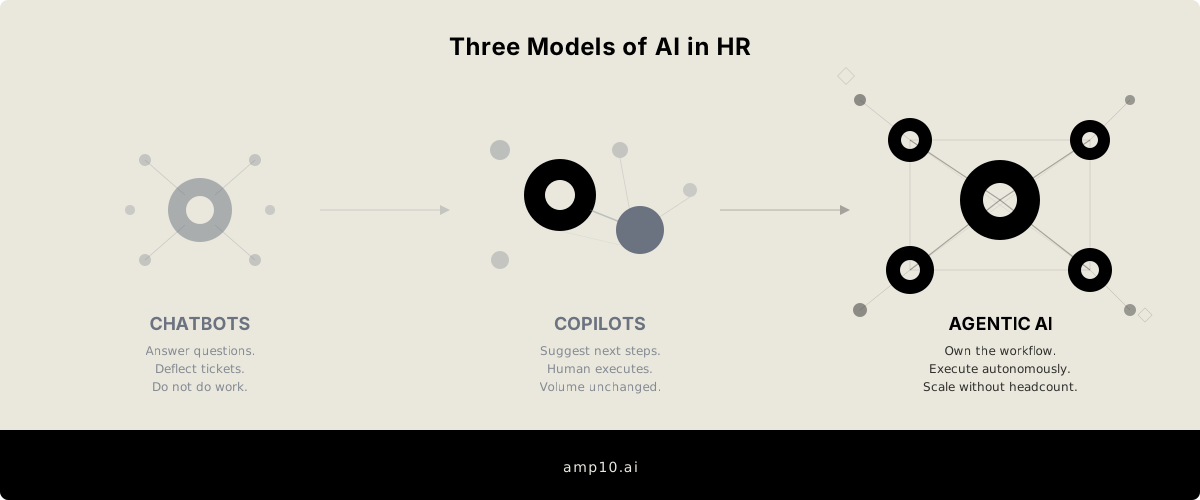
Chatbots were the first wave. They answer employee questions, handle basic self-service requests, and deflect tickets from HR service desks. They are effective for what they do, but a chatbot cannot screen a candidate, coordinate an interview, or run an onboarding workflow. A chatbot responds to questions, and it does not do work.
Copilots represent the current wave. They sit beside your team and suggest next steps, offering to draft a job description, recommend a shortlist of candidates, or surface insights about your hiring pipeline. The value is real, but the human remains in the driver’s seat for every action. The copilot suggests, and the recruiter or HR manager reviews, approves, edits, and executes. Every workflow still depends on someone on your team to push it forward.
Agentic AI for HR is what comes next, and it represents a fundamentally different model. Agentic AI for HR refers to autonomous AI systems purpose-built for human resources and talent operations that can independently execute multi-step workflows from start to finish. That means screening candidates, coordinating interviews across time zones, following up with hiring managers, routing exceptions to the right person when human judgment is required, and completing the work with full audit trails and governance controls in place. Agentic AI is not waiting for a human to act on its recommendation because it is doing the work itself, autonomously, within clearly defined guardrails.
The gap between a copilot and agentic AI is not incremental. It is the difference between a system that makes your team slightly faster and one that fundamentally changes how much work your team can handle without adding headcount.
Why the Agentic AI vs. Copilot Distinction Matters for HR and Talent
In many parts of the enterprise, copilots are sufficient for the task at hand. A developer using a coding copilot is already sitting at a keyboard making decisions all day, and the copilot accelerates work that the human was going to do regardless.
HR and Talent operations are structurally different. The bottleneck is not that individual tasks take too long. The bottleneck is volume and coordination at scale. A recruiting team handling 500 open requisitions does not need each screening to go 20 per cent faster. They need the screening to happen without a human doing it at all, so that the humans on the team can spend their time on the decisions that actually require their expertise, including evaluating culture fit, negotiating offers, and building relationships with hiring managers.
This is precisely where copilots fall short in HR and Talent. A copilot that drafts a screening summary still requires someone to read it, agree with it, and click the button to proceed. Multiply that by 500 requisitions and the copilot has not reduced the workload in any meaningful way. It has made each individual task slightly less tedious while leaving the total volume of work exactly where it was.
Agentic AI for HR solves the volume problem because the AI Teammate does not need a human in the loop for every action. It screens the candidates. It schedules the interviews. It sends the confirmations. It handles the reschedule when the hiring manager’s calendar changes. It escalates to your team when something falls outside its defined scope. The human stays in control of policy, priorities, and exceptions, while the AI Teammate handles the execution. This is what we mean when we talk about AI Teammates that own outcomes rather than AI that merely assists.
What to Look for When Evaluating Agentic AI for HR
If you are a CHRO or VP of HR and Talent evaluating AI right now, the most important question to ask any vendor is this: does your AI suggest, or does it execute?
A copilot will tell you what to do. An AI Teammate will do it for you, within the guardrails you set, using the systems your team already works in.
There are several other questions worth asking as part of your evaluation. Does the AI operate inside your existing systems of record, including Dayforce, iCIMS, UKG, and Workday, or does it require a new platform? Does it come with full audit trails and governance controls, or does it operate as a black box? Is it pre-trained for specific HR and Talent roles, or is it a general-purpose model that your team has to configure from scratch? And does it work across multiple systems of record, or is it locked inside a single vendor’s platform?
For a deeper look at how agentic AI transforms the recruiting function specifically, see our guide to agentic AI for recruiting.
These questions matter because autonomous AI in HR involves sensitive data, regulated processes, and consequential decisions about people. The governance layer is not optional. Shaun and I spent three years building AI governance infrastructure at FairNow with Guru Sethupathy specifically because we learned, through years of enterprise deployments at Ideal and Dayforce, that trust is the prerequisite for adoption. Agentic AI without governance is a liability. Agentic AI with governance built in from day one is a force multiplier for every HR and Talent team that deploys it.
The Platform Trap: Why Cross-System Agentic AI Matters
There is another dimension to the agentic AI vs. copilot conversation that HR and Talent leaders should be aware of. Every major system of record vendor, including Workday, SAP, Oracle, Dayforce, and ServiceNow, is now shipping their own version of agentic AI. In every case, those agents only work inside that single platform.
If your organization runs Workday for HCM and iCIMS for recruiting, Workday’s agents cannot touch your iCIMS workflows. If you use Dayforce for payroll and UKG for scheduling, Dayforce’s agents cannot operate in UKG. Each vendor’s AI is locked to its own ecosystem, and for HR and Talent teams that operate across multiple systems, which is the reality for most enterprises, platform-native agents solve only a fraction of the problem.
Agentic AI for HR that works across systems of record, using the tools your team already has, is a fundamentally different proposition. That is the approach we took when we built Amp. Our AI Teammates operate inside Dayforce, iCIMS, UKG, Workday, and more, not as a replacement for any of them, but as an autonomous execution layer that sits on top and works across all of them. This is what we call the Digital Labor layer for HR: AI Teammates that share the workload with your team, operating within your existing systems, your existing access controls, and your existing audit policies, with zero disruption and no new platforms to deploy.
Learn how this works for HR operations and onboarding.
The Shift From Copilots to Agentic AI Is Already Under Way
Gartner’s 2026 CHRO Priorities survey found that the number one priority for CHROs this year is harnessing AI to fundamentally change how HR operates. Not to assist at the margins. Not to augment individual tasks. To fundamentally change the operating model of the HR and Talent function.
That language matters because it signals that HR leaders are no longer asking whether AI can help. They are asking how much of the operational workload AI can own. The answer from a chatbot is very little. The answer from a copilot is some, but only with a human reviewing and approving every step. The answer from agentic AI for HR is most of it, with humans focused on the strategic, high-judgment work that requires their expertise.
Shaun and I have been building technology for HR and Talent teams for over a decade. We co-founded Ideal, which was one of the first platforms to apply AI to talent screening at enterprise scale. We spent years inside Dayforce after the acquisition, learning how enterprise HR technology actually operates at scale. We built AI governance infrastructure at FairNow. That full arc, from AI screening to enterprise integration to AI governance, is what convinced us that this moment, the shift from copilots to agentic AI for HR, is the most consequential change in HR technology since the move to cloud.
We built Amp because we believe the next generation of HR and Talent technology is not about better tools for your team to operate. It is about AI Teammates that share the workload, operate within your team’s norms and systems, and deliver completed work you can trust. You pay for work done, not seats licensed.