
I have a vivid memory of when I realized AI trust was going to be a big deal. At my previous company, Ideal, we developed algorithms to help screen and match job candidates. In the early days I admit, we didn’t think about AI trust, governance or fairness, we just saw a problem and wanted to solve it. That changed in October of 2018 when I read a BBC article titled “Amazon scrapped ‘sexist AI’ tool.” As I read the article, it dawned on me that we were using similar techniques. I also received phone calls and emails from customers all week asking me if this could be happening with our AI.
Ever since that article I have been convinced that trust is one of the biggest challenges with true AI adoption at scale. Here’s the reality 7 years later: Deloitte reports that close to 75% of enterprises plan to deploy agentic AI within two years. But only 21% have mature governance frameworks in place. That gap — between “we’re deploying this” and “we actually know what it’s doing” — is where trust breaks down.
So let’s talk about what a real trust stack for agentic AI in HR actually looks like. Not theory. Not buzzwords. Just the three pillars that’ll keep your AI Teammates working with you, not around you.
What Are We Even Talking About?
Before we go further, let me be clear on the terms. When I say “Agentic AI for HR,” I’m talking about autonomous AI systems that can make decisions, take actions, and learn from outcomes — all with minimal human intervention on each individual task. Not chatbots. Not copilots that need you to click a button after every suggestion. Actual autonomous systems.
At Amp, we call these “AI Teammates” — and that language matters. They’re not tools you use; they’re team members you govern, trust, and hold accountable.
And “Digital Labor for HR”? That’s the outcome: AI systems that handle the work traditionally done by human HR staff — offboarding workflows, compliance checks, interview scheduling, offer letter generation, the whole stack.
The challenge is that most organisations bolt governance onto these systems after they’re live. We did it differently at Amp, and I’ll tell you why in a moment. But first, let me break down the three pieces of a proper trust stack.
1. Autonomy Boundaries: What Your AI Teammates Can and Cannot Do
A recurring theme in my conversations with HR leaders is focused on value. They have deployed AI in pockets but still aren’t getting the value promised. Until AI can make decisions and complete tasks, I fear they may not see the 10X return on their deployments that they hoped. Naturally, one question keeps coming up: What decisions can an AI Teammate make on its own?
How do we start to answer this question? If we think about AI as teammates, not systems, I find it becomes easier. We apply boundaries all the time to our human workforce. For example, a new grad that we just onboarded gets less privilege to complete specific tasks or have access to specific data than a senior colleague does. Concepts such as least privilege, often enforced through technical controls around identity management and access, have been in the Enterprise for a long time, and I argue we must apply this same way of thinking to AI.
So autonomy boundaries are step one. And they’re not binary.
Think of it in tiers:
- Full autonomy. The AI Teammate completes the action without a human sign-off. Example: Routing a routine policy question to the right HR team member.
- Human-in-the-loop. The AI Teammate flags an action, recommends a decision, and a human approves before it moves forward. Example: An AI Teammate drafts a severance agreement, but your legal team reviews and approves it.
- Escalation only. The AI Teammate detects a scenario that falls outside its training and bounces it to a specialist immediately. Example: A compensation decision that involves exceptions or complex equity implications.
The trick is defining these boundaries before deployment, not after your first mistake goes live. And they should map to your organization’s risk tolerance — not some Silicon Valley playbook that worked for a different company.
Here’s what we found: Most organizations need Tier 1 autonomy on maybe 20% of workflows, Tier 2 on 60%, and Tier 3 on 20%. That distribution should be your starting point.
2. Audit Trails: Every Action Logged, Every Decision Explainable
There is a saying in engineering, “telemetry is more important than accuracy.” People fail. Systems fail. Not being able to explain why things fail, and adjust quickly, is where things really start to break down.
Workday’s Sana product is honestly brilliant here. It inherits Workday’s security model, permissions context, and audit infrastructure. If you’re all-in on Workday, you get governance baked in from day one. That’s fantastic.
But here’s the reality for most HR stacks: You’re not using just Workday. You’re running Dayforce for payroll, iCIMS for recruitment, UKG for scheduling, maybe Workday for core HR. Your AI Teammates need to work across all of that. And if each system has its own audit trail with no unified view, you’re flying blind.
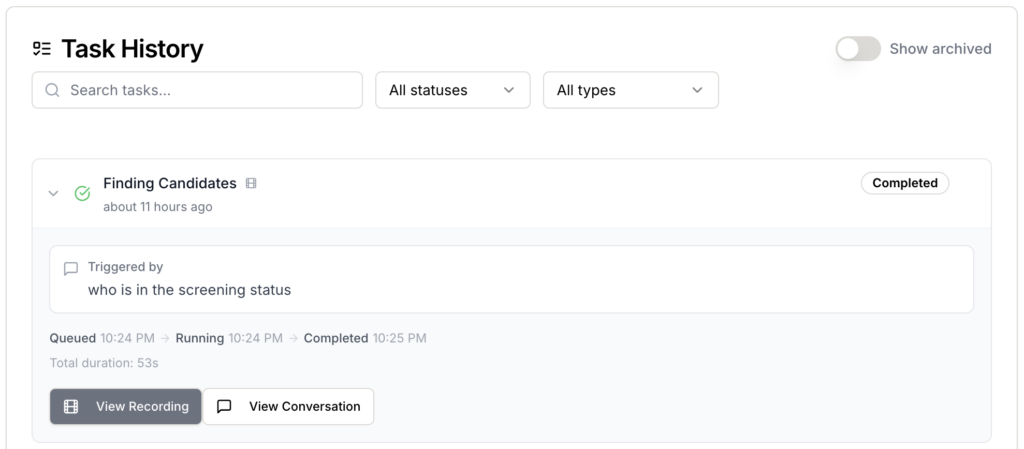
This is where Amp’s approach made a real difference. We built audit trails into the platform from the ground up. Every action an AI Teammate takes — every email sent, every form filled, every workflow triggered — is logged with:
- Who initiated the action (Human or AI Teammate, and which one)
- What action was taken (exactly)
- When it happened (timestamp)
- Where it happened (which system, which data entity)
- Why it happened (what triggered the action, what decision logic was applied)
That’s not a nice-to-have when you’re facing a compliance audit or an employment lawsuit. That’s table stakes.
And here’s the part most vendors skip: Your compliance team, legal team, and IT team need different views into those same audit trails. Your auditor doesn’t need to see every keystroke; they need to see decision points and approvals. Your legal team needs to see the full context of any action that could land you in court. Your IT team needs to see system access and data flows.
One audit trail. Multiple views. That’s built-in governance.
3. Cross-Functional Governance: HR, IT, Legal, and Compliance at the Table
This is the part where most deployments fall apart.
You greenlight agentic AI in HR. HR owns the deployment. IT supports the infrastructure. Legal is vaguely aware. Compliance finds out after something goes wrong.
That’s not governance. That’s chaos with an org chart.
Real governance is a standing monthly meeting — or more often, depending on scope — where:
- HR owns the business rules and outcome definitions (What should the AI Teammate do? How will we know if it’s working?)
- IT owns the architecture and access controls (What systems does it touch? How is data flowing? What are the failure modes?)
- Legal owns the risk assessment (What could go wrong? What are our liability exposures?)
- Compliance owns the audit and evidence trail (Are we meeting our regulatory obligations? Can we prove it?)
Each function gets a voice. Each function has veto power if there’s a risk they can’t accept.
I’ve seen this model work at scale. And I’ve seen it fail spectacularly when one function — usually HR — is left owning the whole thing.
Here’s the framework I’d recommend:
- Pre-deployment governance: Define autonomy tiers (Tier 1 / Tier 2 / Tier 3) for each workflow, enforced through strong AI Identity and Access Management.
- Audit trail specification: Agree on what gets logged, who sees what, and what triggers escalation.
- Monitoring and escalation: Establish SLAs for detecting anomalies, escalating issues, and human review cycles.
- Quarterly reviews: Pull the four functions back together. Look at the data. Are the AI Teammates performing as expected? Do the governance rules need to shift?
It sounds like bureaucracy. It’s not. It’s the difference between an AI Teammate that your organization trusts and one that you’re constantly second-guessing.
Why Amp’s Approach Is Different
When we built AI Teammates, governance wasn’t an afterthought. It was architecture.
That means:
- AI Teammates work across your full HR stack: Dayforce, iCIMS, UKG, Workday. Governance doesn’t depend on all your data living in one system.
- Every action is logged across your entire HR tech stack, not just within Amp’s system.
- Autonomy boundaries are configurable down to the workflow level, and you can change them as you learn.
- The audit trail is designed for compliance, not just operational debugging.
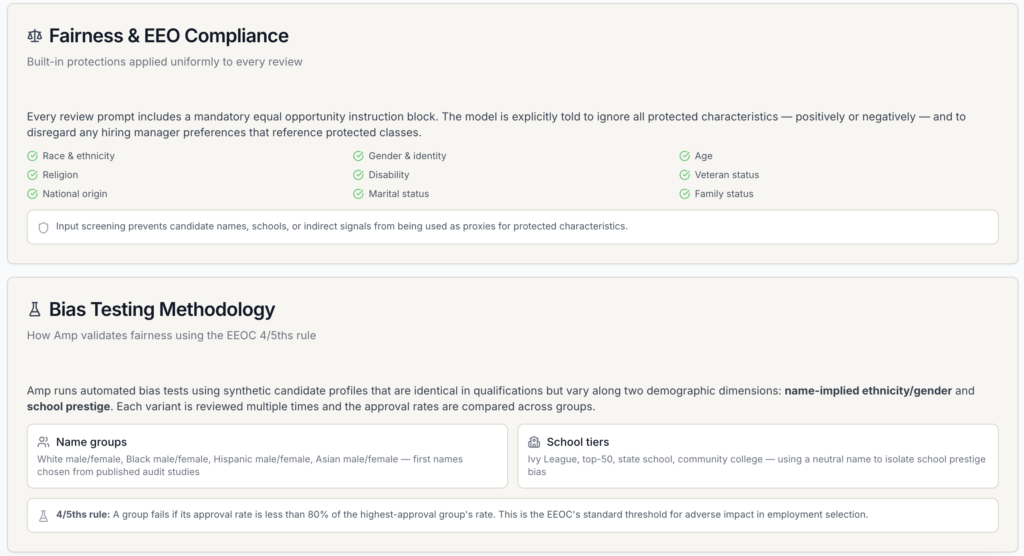
We’re not perfect. We’ve made mistakes. We’ve learned what happens when you give AI Teammates too much autonomy too fast. But we’ve learned in a way that’s made the platform safer, not riskier, for every organization that uses it.
FAQ: Agentic AI Governance in HR
Do I need all three pillars of the trust stack from day one?
You need the architecture from day one. That means you need audit trails and cross-functional sign-off before you deploy anything. But you can start conservative on autonomy — Tier 2 (human-in-the-loop) for most workflows — and expand gradually as you build trust.
What happens if an AI Teammate makes a decision I disagree with?
You reverse it, and the system logs the reversal. That triggers a learning cycle where your AI Teammate’s decision logic is reviewed. Was the decision wrong? Was the business rule misunderstood? This is where audit trails become learning tools, not just compliance instruments.
Who decides the autonomy tiers?
Your cross-functional governance team, with final authority in the hands of whoever owns the risk. Usually that’s HR for business rules, Legal for employment-related decisions, and Compliance for regulatory exposure.
How often should we review governance rules?
Monthly at minimum, especially in the first year. After that, quarterly is probably fine unless something breaks. But “breaking” is often when you find out your governance rules were wrong, so build in a rapid-escalation process.
Can I keep governance lightweight and add it later?
You’ll regret it. I’ve seen this play out. Six months in, you’re dealing with a crisis because an AI Teammate did something you didn’t plan for, and now you’re scrambling to understand what happened. Start strict, loosen gradually.
What’s the difference between this and just having a human review everything?
Speed, scale, and consistency. An AI Teammate can handle 1,000 routine decisions with a Tier 2 (human-in-the-loop) framework faster and more consistently than a human could handle them alone. But every decision is logged and reviewable. You get the best of both worlds.
What if my SOR vendor (Workday, Dayforce, etc.) adds their own AI agents?
That’s fine — actually, it’s likely inevitable. The governance principles remain the same: autonomy boundaries, audit trails, cross-functional oversight. Make sure your governance framework extends to any AI system touching your HR data, not just Amp.
Do I need specialized compliance people to manage this?
You need one person per function (HR, IT, Legal, Compliance) who owns the governance conversation. That person doesn’t need to be full-time on this, but they need to be in the room and have the authority to push back.
So, What’s Your Trust Stack?
Here’s my closing question for you: If you deployed agentic AI in HR tomorrow, could your compliance team explain every decision the system made? Could your legal team point to the human approval chain? Could your IT team show you the data flows and access logs?
If the answer is “probably not,” you’re not ready yet. That’s not a criticism, most organizations aren’t. But it’s the truth.
The trust stack isn’t restrictive. It’s not slowing down your deployment. It’s the opposite. It’s the framework that lets you move faster, with confidence, knowing that when something goes wrong, you’ve got the audit trail and governance structure to fix it quickly.
To see how Amp’s AI Teammates deliver built-in governance across your full HR stack, request a demo.