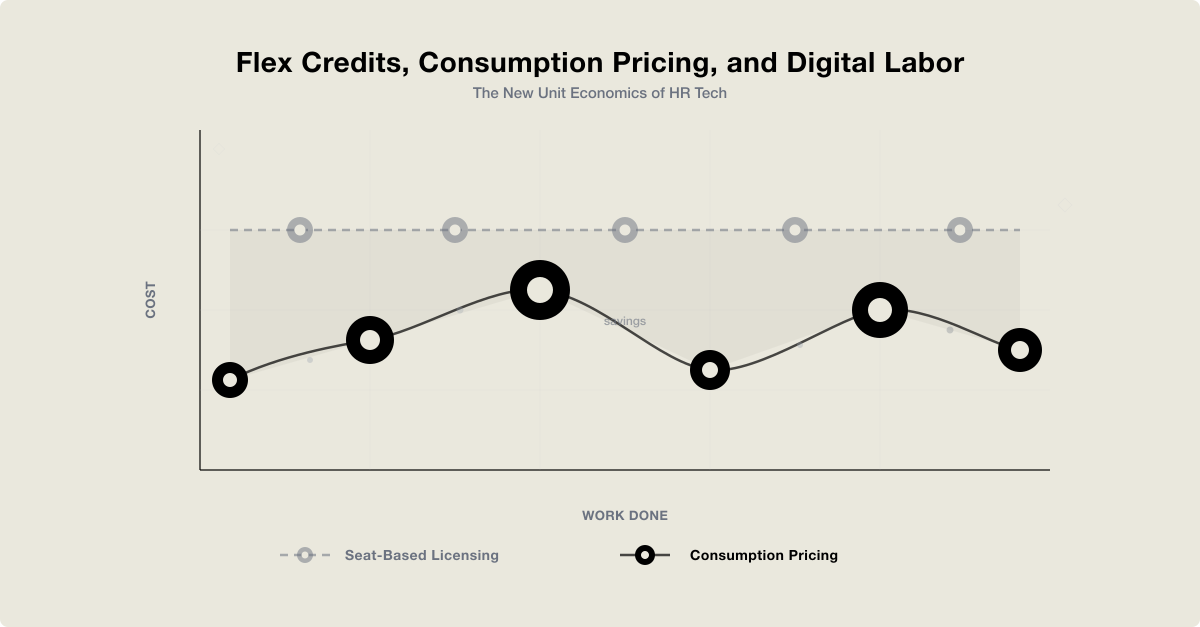

The unit economics of HR software are shifting beneath our feet. For two decades, the industry has operated on a simple bargain: you licence seats, you pay per user per month, and you scale your costs linearly with headcount. That model is evolving. Workday introduced Flex Credits at Workday Rising in September 2025 to price AI agent usage by consumption rather than by licence. Zylo’s 2026 SaaS Management Index reports that 78 per cent of IT leaders have encountered unexpected charges from AI-driven consumption models. The era of fixed-seat licensing is giving way to something more fluid, more dynamic, and for organisations that do not manage it carefully, more complex to forecast.
This shift is not inherently bad. Consumption-based pricing, when designed well, can align vendor incentives with customer outcomes. When the transition is managed poorly on the buyer’s side, it can catch organisations off guard. The question is not whether consumption pricing will dominate HR tech; it already is. The question is how organisations can extract value from this new model while maintaining budgetary predictability, and how they should think about ROI when pricing has become variable.
The Rise of Consumption Pricing in HR Tech
Flexera’s 2026 analysis shows that 85 per cent of SaaS leaders are now using some form of usage-based pricing. In HR, this transition has been driven by the arrival of agentic AI, software that autonomously executes work and makes decisions rather than simply supporting human decision-making. A Workday Sana Self-Service Agent with 300+ skills can handle thousands of transactions per month. The number of transactions, not the number of users, determines the cost. This is consumption pricing by necessity.
The logic is sound. If you build an AI agent that does the work, the economic value you deliver scales with usage. If you charge by seat, you create a structural tension; the better your agent performs, the fewer human hours it replaces, and the fewer seats the customer needs to licence. Consumption pricing resolves this tension by tying cost to value delivered. Both vendor and customer benefit when the agent works harder, provided the pricing model is transparent and the customer can forecast usage accurately.
HR software vendors have recognised this shift and are introducing consumption models alongside their core platforms. Flex Credits at Workday are a leading example. They sit atop the seat-based subscription, creating a two-tier cost structure that gives customers access to AI capabilities on a pay-as-you-go basis. The challenge for buyers is that 78 per cent of organisations report unexpected bills, not because the pricing is unfair, but because IT leaders have not yet adapted their budgeting processes for variable costs in HR. When consumption charges arrive mid-quarter without internal forecasting in place, friction between finance and operations accelerates.
The Seat-Based Model Was Not Built for Agentic AI
The seat-based licensing model emerged in the 1990s and 2000s, when software was a tool that amplified human effort. ERP systems, HCM platforms, and ATS software all embodied this assumption: each user licence represented a person using software to do their job faster. Cost was proportional to organisational size, which made budgeting simple. You knew your headcount; you knew your cost.
Agentic AI introduces a fundamentally different dynamic. An AI Teammate does not use software; it deploys software to execute work. It is not a tool for one person; it is a worker. A single AI Teammate instance can replace the throughput of ten, fifty, or a hundred human operators, depending on the task. If you charge by the Teammate (the seat equivalent), the customer’s incentive is to underprovision agents. If you charge by the work done (consumption), the customer’s incentive is to monitor every transaction cost, which creates overhead and complexity.
Neither model is perfect, but consumption pricing in its current form, often introduced as a new layer alongside existing seat-based platforms, requires organisations to rethink how they budget for HR technology. It treats AI work as a variable cost, which is economically accurate but operationally unfamiliar for most HR and finance teams.
How Cross-SOR Agentic AI Delivers Better Unit Economics
Shaun and I have built and sold three HR software companies together. Field ID was acquired by Fortune Brands in 2012. Ideal was acquired by Dayforce in 2021. FairNow was acquired by Optro, backed by Hg Capital, in 2025. Each company taught us something different, but the common thread across all three was this: the unit economics of HR software improve dramatically when you solve cross-system problems rather than vertical problems within a single platform.
Amp’s approach complements what Dayforce, iCIMS, UKG, Workday, SAP SuccessFactors, and Oracle HCM are building by adding a cross-platform intelligence layer. Amp’s AI Teammates work across your HR stack. They use each of these systems of record, orchestrating work wherever it needs to happen without requiring organisations to adopt separate consumption models on each individual platform.
This architecture delivers strong unit economics because it allows organisations to centralise their agentic AI investment. Rather than managing multiple consumption tiers across several platforms, organisations can deploy a single set of AI Teammates that work across all of them, paying only for the work done through Amp’s consumption model. The unit cost per transaction is lower because the agent is not duplicated across platforms; the agent is centralised and the work is distributed to the right system.
More importantly, this model aligns incentives correctly. Amp’s revenue scales with the work the AI Teammates do, which means Amp’s incentive is to make those Teammates more efficient, more accurate, and more broadly applicable. The customer’s incentive is to deploy them widely because the cost is transparent and predictable: you pay for work done, not seats licensed. The pricing is metered in real time, giving organisations full visibility into what they are spending and why.
The Shift From Seats to Work: Implications for Procurement and Finance
For procurement teams, this shift changes everything about how to evaluate HR software. The old rubric was simple: how many seats do we need, and what is the cost per seat per month? The new rubric is more complex: what work will the AI do, how much will it cost per transaction, and how does that compare to the cost of the human work it replaces?
This requires organisations to do something many have never done: measure the output of HR operations. How many candidates processed? How many pay runs executed? How many employee relations cases resolved? Most organisations do not track these metrics, which means procurement and finance have no baseline against which to evaluate consumption pricing. This is why unexpected bills are common. Organisations adopt consumption models without having any idea how many transactions they actually process. The surprise comes in month two when the first invoice arrives and reveals the true volume of work.
Organisations that have implemented consumption-based pricing successfully, in product analytics, cloud infrastructure, and HR, tend to share one trait: they have invested in usage metering and forecasting before signing the contract. They have answered the question: how much work will the system actually do? Only then can they negotiate consumption rates that make sense.
The best consumption models in HR tech are those that give organisations granular visibility into usage and cost drivers in real time. Not monthly surprises; not quarterly true-ups. Real-time dashboards that show exactly what is being consumed, at what cost, and what the ROI is. This transparency builds trust between vendor and customer and turns consumption pricing into a genuine partnership rather than an adversarial negotiation.
Why Consumption Pricing Makes Sense (and How to Adopt It Well)
Consumption pricing is most effective when three conditions are met. First, the cost to the vendor of serving an additional unit of consumption is lower than the price charged. Second, the customer’s value derived from that unit is higher than the price. Third, the customer can forecast and manage consumption levels dynamically. They have the visibility and flexibility to optimise their spend.
In HR tech, the first two conditions are usually true. An AI agent executing a background check, a payroll calculation, or an employee record update costs the vendor pennies. The customer’s value from automating that work is orders of magnitude higher. Where consumption pricing requires the most attention is the third condition: visibility and flexibility. Once you have built payroll, recruiting, or benefits administration on a platform, your consumption patterns are largely determined by business volume. The key is ensuring you have the data and the contractual flexibility to manage those costs proactively.
This is where Amp’s cross-SOR model offers a structural advantage. Because the AI Teammates work across platforms, organisations gain a unified view of their agentic AI spend rather than tracking consumption across multiple systems independently. The intelligence layer is centralised, the work is distributed, and the economics are transparent. Organisations retain flexibility because Amp is designed to complement whatever systems of record they choose, not to compete with them.
How to Evaluate Consumption Pricing in HR Tech: Questions to Ask
The shift to consumption pricing requires organisations to ask new questions during procurement. What is the unit price, and how is it defined? Is it per transaction, per user, per workflow, or per outcome? If the definition changes, does the price stay the same? What data will you have access to in order to forecast consumption? Can you set budgets and alerts? Is there a minimum spend, a maximum price, or a flat-rate option? Can the rate be negotiated based on committed volume? Is consumption tracked in real time or batched monthly?
For vendors, the equivalent questions apply in reverse. How transparent will consumption metrics be? What guardrails will prevent bill surprises? Is there a price cap or a commitment period? Will consumption rates stay stable, or can they change? If they change, what is the notice period? These are not academic questions; they determine whether an organisation will trust the vendor enough to deploy agentic AI at scale.
The organisations that will win in the consumption-pricing era are those that instrument their HR operations, measure baseline costs, negotiate consumption rates based on data rather than assumptions, and choose vendors whose incentives are aligned with outcomes and whose pricing is fully transparent.
Entity Definitions
Agentic AI for HR: Autonomous software systems that independently execute HR processes, make decisions within defined parameters, and orchestrate work across multiple HR platforms without requiring human intervention for each transaction. Agentic AI differs from traditional copilots or assistants, which amplify human decision-making; Agentic AI replaces repetitive decision-making entirely.
AI Teammates: Amp’s product category. AI Teammates are agentic AI systems deployed within an organisation’s HR stack. They work across multiple platforms and execute end-to-end workflows including recruiting, onboarding, payroll, compliance, benefits, and employee relations.
Digital Labor for HR: The use of agentic AI to perform work traditionally done by human HR operators, compliance specialists, recruiters, and benefits administrators. Digital Labor is measurable in terms of tasks executed, time saved, and outcomes delivered. It is distinguished from automation by the fact that it includes decision-making, not just workflow routing.
Frequently Asked Questions
If I move to consumption pricing, will my costs go up?
Not necessarily. Consumption pricing is lower cost when three conditions hold: your usage is predictable, the vendor’s unit price is transparent and competitive, and you have the flexibility to adjust if your needs change. If any of these conditions is missing, you should invest in baselining your usage before committing. The organisations that benefit most from consumption pricing are those that have measured their HR operations and can forecast usage in advance.
How is consumption pricing different from pay-per-use cloud infrastructure?
Cloud consumption pricing (AWS, Azure) is paid monthly based on actual usage, but the unit prices are stable and transparent. Cloud infrastructure is also fungible; if one provider becomes too expensive, workloads can move to another. HR software consumption pricing is newer and still maturing. The industry is moving toward the transparency and portability that cloud infrastructure has achieved, but buyers should ask for real-time metering and clear unit definitions during procurement. The better comparison is not cloud infrastructure but SaaS consumption models in analytics and marketing automation, where buyers who baseline usage in advance consistently get better outcomes.
Should we demand flat-rate pricing instead of consumption?
Flat-rate pricing has its own trade-off. It removes the variability of consumption costs, but it often bundles more functionality or features than you need, and you pay the same price whether you use the system extensively or minimally. The optimal pricing model depends on your organisation’s consumption patterns. If your HR team has high variance in transaction volume (seasonal hiring, restructures, payroll cycles), consumption pricing may be cheaper if properly negotiated. If your volume is stable, flat-rate pricing is simpler and more predictable.
What should we do if our current vendor introduces consumption pricing?
First, baseline your current usage. How many payroll runs, recruiting workflows, benefits transactions, and employee records does your system process per month? Second, ask your vendor for historical consumption data and a projection of what you would have been charged under the new model. Third, evaluate whether the new model aligns with your usage patterns. Consumption pricing is an industry-wide evolution, and most major vendors are introducing thoughtful models. The key is ensuring you have the data to evaluate them accurately and the internal processes to forecast variable costs.
Is consumption pricing here to stay in HR tech?
Yes, for agentic AI products, consumption pricing is likely to become the default. The reason is fundamental: AI agents scale differently from human-centric software. A consumption model aligns vendor incentives with customer outcomes in a way that seat-based pricing cannot. However, consumption pricing does not have to mean unpredictable costs. The best consumption models in HR will be those that give organisations transparency, predictability, and control.
How does Amp’s consumption pricing model compare to traditional HR software?
Amp charges based on the work that AI Teammates execute, not on seats licensed or platforms accessed. You pay for transactions completed, recruiting workflows, payroll records processed, employee service interactions resolved, rather than paying by user or by platform. This is cost-effective for most organisations because Amp’s Teammates work across your entire HR stack, providing a single consumption layer rather than requiring separate agentic AI investments on each individual platform. The rate is transparent, metered in real time, and based on actual transactions, not estimates.
What happens if we want to reduce our consumption with Amp?
You can reduce consumption at any time. If you deploy fewer AI Teammates or reduce the workflows they execute, your costs drop immediately. There is no minimum contract, no penalty for underutilisation. This is the inverse of seat-based licensing, where you pay for the seat regardless of how much you use it.
If You Are Navigating the Shift to Consumption Pricing
In a world where HR software pricing is becoming more variable and more complex, the question is not whether you will pay for consumption, but whether you will understand what you are paying for. The organisations that will win in this era are those that instrument their HR operations, baseline their costs, and choose vendors whose incentives are aligned with the work delivered, not the seats licensed.
We built Amp to be the cross-stack execution layer for HR and Talent, with consumption-based pricing tied to the work AI Teammates actually do across Dayforce, iCIMS, UKG, Workday, SAP SuccessFactors, and Oracle HCM. If you would like to see how that works inside the systems you already run, we would welcome the conversation.