

There is no shortage of opinions about agentic AI in HR right now. Every analyst firm, every platform vendor, and every consulting house has a perspective on what is happening, what will happen next, and why their clients should care. What has been missing, until now, is a single place where CHROs and HR technology leaders can find the actual data, sourced and cited, that separates the hype from the trajectory. This is that page.
I have spent the last fifteen years building HR technology companies, from Ideal (acquired by Dayforce in 2021) to FairNow (acquired by Optro in 2025) to Amp, where my co-founder Shaun Ricci and I are building pre-trained AI Teammates for HR and Talent teams. I am not a disinterested observer of this category, and I will not pretend to be one. But the statistics I am about to walk through come from Gartner, McKinsey, Deloitte, IDC, Forrester, and Josh Bersin, and they paint a picture that is far more compelling than any single vendor narrative, including ours.
Before I walk through the numbers, a brief orientation on the terms that matter. Agentic AI in HR refers to autonomous AI systems that independently execute HR workflows, from candidate screening to interview coordination to onboarding, without requiring step-by-step human direction. At Amp, we call these systems AI Teammates, because they own outcomes the way a teammate does, not the way a tool does. At the C-suite and board level, analysts increasingly use the term Digital Labor to describe this new category of workforce capacity. These are not interchangeable labels for the same thing; they reflect different layers of the same structural shift, and understanding the distinction matters for how you build your business case and communicate it to your board.
If you are a CHRO trying to build that business case, a VP of Talent evaluating agentic AI in HR for the first time, or an analyst looking for citable benchmarks, this is the resource I wish had existed when we started building Amp.
Agentic AI in HR Adoption Is Accelerating Faster Than Any Prior Wave of HR Technology
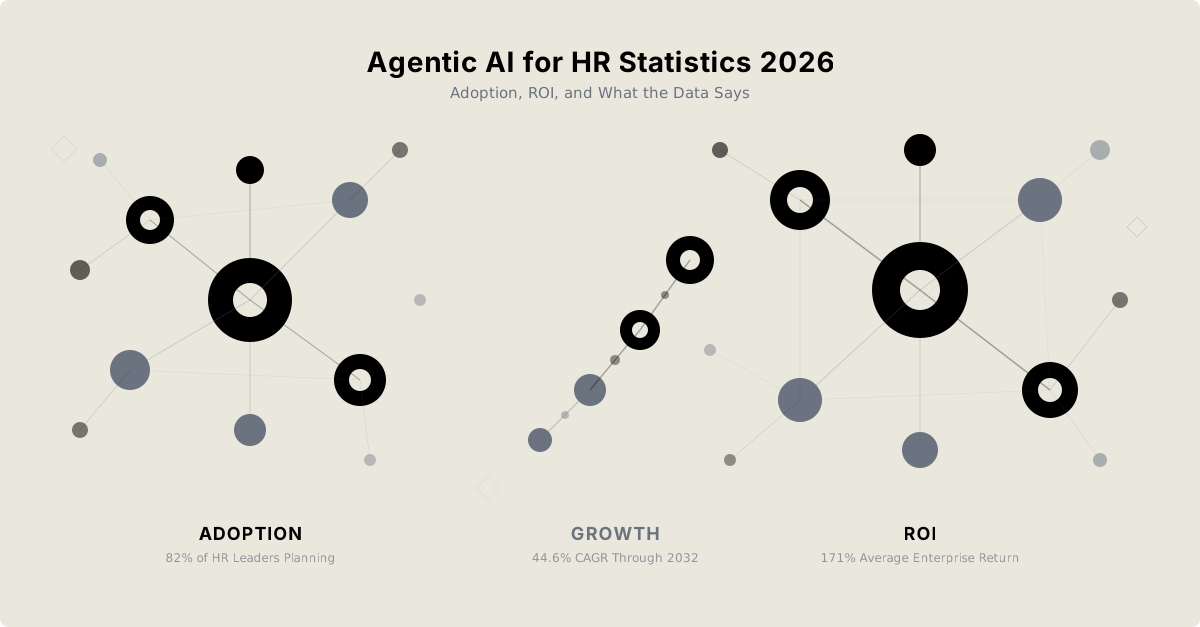
The adoption numbers for agentic AI in HR are unlike anything I have seen in my career. According to Gartner, 82 per cent of HR leaders plan to adopt some form of agentic AI within their functions, making this the fastest-moving technology adoption wave in the history of HR technology (Gartner, 2025). To put that in context, cloud HCM adoption took nearly a decade to reach comparable penetration levels among large enterprises.
Gartner further predicts that 40 per cent of enterprise applications will feature task-specific AI agents by the end of 2026, up from less than five per cent in 2025 (Gartner, August 2025). That is an eightfold increase in a single year, and HR is one of the three functions leading the charge alongside customer service and finance.
McKinsey’s global survey reveals that 23 per cent of organisations are already actively scaling agentic AI systems, with an additional 39 per cent in experimental phases (McKinsey, 2025). That combined 62 per cent engagement rate tells us something important: this is not a future conversation for most large enterprises. It is a present-tense operating decision.
One in four leaders surveyed by McKinsey said they expect AI agents to act as autonomous team members in the short term, not as assistants, not as chatbots, but as colleagues who own outcomes and execute workflows independently (McKinsey, 2026).
The Market for Agentic AI in HR Is Growing at a Pace That Demands Attention
The financial scale of agentic AI investment reinforces the adoption data. The global agentic AI market reached approximately USD 9.1 billion in 2026, according to Fortune Business Insights and multiple corroborating analyst estimates. IDC projects that total AI spending will grow 31.9 per cent year over year between 2025 and 2029, with agentic systems capturing an increasing share of that investment, and estimates that agentic AI already represents 10 to 15 per cent of enterprise IT spending in 2026 (IDC, 2025).
The long-term projections are equally striking. MarketsandMarkets forecasts the agentic AI market expanding from USD 7.06 billion in 2025 to USD 93.20 billion by 2032, representing a compound annual growth rate of 44.6 per cent. That is not incremental growth. That is a new category forming in real time.
For CHROs, the implication is clear: the budget is moving. IDC notes that agentic AI will exceed 26 per cent of worldwide IT spending by 2029, reaching USD 1.3 trillion. HR and Talent functions that do not have an agentic AI strategy by the end of 2026 will find themselves competing for budget allocation against functions that already do.
Agentic AI in HR Delivers Measurably Higher ROI Than Copilots and Traditional Automation
This is the statistic that matters most to anyone building a business case, and it is also where the data is most definitive. The efficiency gains from agentic AI are structurally different from what copilots and traditional automation deliver, because the architecture is structurally different.
Organisations deploying agentic AI report average ROI of 171 per cent, with U.S. enterprises specifically forecasting 192 per cent returns (Arcade.dev, citing aggregated enterprise data). Enterprises are seeing cost reductions of 30 to 50 per cent in the functions where agentic AI has been deployed, with some organisations reporting returns in as little as two weeks.
The comparison with copilots is instructive. Copilots improve human productivity incrementally, typically delivering five to ten per cent efficiency gains by surfacing information and suggesting next steps. Agentic AI, by contrast, delivers 20 to 50 per cent efficiency gains because it does not assist with workflows; it executes them autonomously (HCLTech, 2026). The difference is not one of degree. It is one of kind.
IBM’s deployment of agentic AI for internal HR support through its AskHR system achieved a 94 per cent containment rate for common HR queries, contributed to a 75 per cent reduction in support tickets raised, and generated more than 11.5 million employee interactions in a single year (IBM, 2024). That is not a pilot programme. That is enterprise-scale proof.
What Gartner, Josh Bersin, and Deloitte Are Telling CHROs About Agentic AI in HR
The analyst community has converged on a single message: agentic AI in HR is the defining technology shift of this decade for the CHRO function.
Josh Bersin has identified more than 100 potential AI agents for HR, grouped into what he calls “superagent families” spanning employee services, recruiting, performance management, coaching, learning and development, and workforce management (Josh Bersin Company, January 2026). He projects that AI agents and superagents will enable up to 30 per cent fewer traditional HR roles while dramatically improving employee services, and describes this as the largest HR transformation in decades.
Deloitte’s 2026 Global Human Capital Trends report found that seven in ten business leaders say their primary competitive strategy over the next three years is to be fast and nimble, and positions agentic AI as the enabling infrastructure for that speed (Deloitte, 2026). Deloitte has gone further, describing this moment as the shift toward a “silicon-based workforce” where organisations must prepare to manage human and digital workers as an integrated talent pool.
Gartner predicts that 15 per cent of day-to-day work decisions will be made autonomously through agentic AI by 2028, up from effectively none in 2024 (Gartner, 2025). For HR specifically, this means that candidate screening, interview coordination, onboarding workflows, and routine employee service requests will increasingly be executed by AI Teammates without human intervention, not because the technology is replacing judgement, but because it is removing the administrative bottleneck that prevents HR and Talent teams from exercising judgement where it matters.
The Talent Acquisition Function Is the Leading Edge of Agentic AI in HR Adoption
Within HR, talent acquisition is where agentic AI is having the most immediate and measurable impact. According to industry surveys, 47 per cent of HR teams are prioritising AI agents for recruiting, and 65 per cent report major gains in onboarding efficiency (Master of Code, 2026).
Josh Bersin’s research found that roughly 75 per cent of talent acquisition leaders said they were not involved in strategic decisions and were instead being used as fulfilment centres, focused on filling requisitions rather than shaping workforce strategy (Josh Bersin Company, 2025). Agentic AI changes this equation by absorbing the high-volume, repetitive execution layer, including candidate screening, interview scheduling, and offer coordination, and freeing talent acquisition professionals to operate as strategic advisors to the business.
This is precisely the thesis behind Amp. Our AI Teammates are purpose-built for HR and Talent teams, operating inside the systems of record that organisations already use, including Dayforce, iCIMS, UKG, and Workday, with zero disruption. They do not suggest. They execute. They screen candidates, coordinate interviews, manage scheduling, and follow through to completion, around the clock, without bottlenecks or delays. And organisations pay for work done, not seats licensed.
The Governance Gap in Agentic AI for HR Is Real, and It Will Determine Who Wins
The data also reveals a significant caution. McKinsey reports that only one in five companies has a mature model for governance of autonomous AI agents (McKinsey, 2026). And Gartner has predicted that over 40 per cent of agentic AI projects will be cancelled by the end of 2027, largely due to governance failures, unclear accountability structures, and integration complexity (Gartner, June 2025).
This is not a reason to slow down. It is a reason to choose carefully. The organisations that will capture the full value of agentic AI in HR are those that deploy solutions with governance built into the foundation, not bolted on after the fact. It is why we built FairNow before we built Amp, and it is why trust and governance are embedded in every AI Teammate we deploy, not offered as an optional add-on.
The human dimension matters as well. Deloitte’s survey found that one-third of workers experienced 15 major changes in the past year, with 68 per cent citing decreased wellbeing and 60 per cent citing increased workload as a result (Deloitte, 2026). Agentic AI deployed thoughtfully should reduce that burden, not add to it. The goal is to amplify what HR and Talent teams can accomplish, not to create another change management crisis.
What These Statistics Mean for CHROs Making Decisions in 2026
The data points in this article are not predictions about a distant future. They describe what is happening now. Eighty-two per cent of HR leaders are planning for agentic AI. Forty per cent of enterprise applications will have embedded agents by year end. Organisations are seeing 30 to 50 per cent cost reductions and 171 per cent average ROI. The talent acquisition function is leading adoption, and the analyst community is unanimous that this is the largest transformation HR has faced in decades.
The question is no longer whether agentic AI in HR will reshape the function. The question is whether your organisation will be among those that deploy it thoughtfully, with governance, integration, and trust at the centre, or among those that are still evaluating pilots while their competitors scale.
If you are a CHRO, VP of Talent, or head of HR operations building your agentic AI strategy this year, we would welcome the conversation. Visit amp10.ai to learn how AI Teammates are helping HR and Talent teams scale output without scaling headcount.
Frequently Asked Questions
What is agentic AI in HR?
Agentic AI in HR refers to autonomous AI systems, often called AI Teammates or Digital Labor, that independently execute HR workflows such as candidate screening, interview coordination, onboarding, and employee service requests. Unlike copilots or chatbots that assist human workers, agentic AI owns outcomes and completes tasks from start to finish without requiring step-by-step human direction. These systems operate inside existing HR technology platforms, including Dayforce, iCIMS, UKG, Workday, SAP SuccessFactors, and Oracle HCM, to deliver 24/7 execution capacity.
What percentage of HR leaders plan to adopt agentic AI?
According to Gartner, 82 per cent of HR leaders plan to adopt some form of agentic AI within their functions. This makes agentic AI for HR one of the fastest-moving technology adoption waves in the history of HR technology, significantly outpacing the adoption curves of cloud HCM and traditional AI-assisted tools.
What is the ROI of agentic AI in HR?
Organisations deploying agentic AI report average ROI of 171 per cent, with U.S. enterprises specifically forecasting 192 per cent returns. Enterprises are achieving cost reductions of 30 to 50 per cent in deployed functions, with some organisations reporting measurable returns in as little as two weeks.
How does agentic AI differ from copilots for HR teams?
Copilots assist human workers by surfacing information and suggesting next steps, typically delivering five to ten per cent efficiency improvements. Agentic AI operates autonomously, executing complete workflows from end to end and delivering 20 to 50 per cent efficiency gains. The distinction is architectural: copilots augment human actions within a single step, while agentic AI orchestrates multi-step workflows across systems independently.
What is Digital Labor for HR?
Digital Labor for HR is a term used at the C-suite and board level to describe the deployment of autonomous AI systems that perform work traditionally done by human employees. It encompasses agentic AI, AI Teammates, and autonomous workflow execution. The term positions these systems as a new category of workforce capacity rather than a software tool, reflecting the shift from technology that assists workers to technology that acts as a worker.
Which HR functions are adopting agentic AI fastest?
Talent acquisition leads adoption, with 47 per cent of HR teams prioritising AI agents for recruiting and 65 per cent reporting significant onboarding efficiency gains. Employee services, interview coordination, and routine HR operations are also seeing rapid deployment, driven by the high volume of repetitive, rules-based tasks in these functions.
How large is the agentic AI market in 2026?
The global agentic AI market reached approximately USD 9.1 billion in 2026. MarketsandMarkets forecasts the market expanding to USD 93.20 billion by 2032 at a 44.6 per cent compound annual growth rate. IDC projects that agentic AI will exceed 26 per cent of worldwide IT spending by 2029, reaching USD 1.3 trillion.
What are the risks of deploying agentic AI in HR?
The primary risk is governance. McKinsey reports that only one in five companies has a mature governance model for autonomous AI agents. Gartner predicts that over 40 per cent of agentic AI projects will be cancelled by end of 2027, primarily due to governance failures and integration complexity. Organisations should prioritise solutions with built-in trust, transparency, and auditability rather than treating governance as an afterthought.
What are analysts saying about agentic AI for HR in 2026?
Gartner, McKinsey, Deloitte, and Josh Bersin have all identified agentic AI as the defining technology shift for the CHRO function. Josh Bersin has catalogued more than 100 potential AI agents for HR and describes this as the largest HR transformation in decades. Deloitte frames it as the emergence of a “silicon-based workforce.” Gartner predicts 15 per cent of day-to-day work decisions will be made autonomously by AI agents by 2028.
How do AI Teammates work with existing HR systems of record?
AI Teammates, such as those built by Amp, are designed to operate inside the systems of record that HR and Talent teams already use, including Dayforce, iCIMS, UKG, Workday, SAP SuccessFactors, and Oracle HCM. They integrate with zero disruption, requiring no new platforms and no rip and replace. This cross-platform approach means organisations do not need to standardise on a single vendor to benefit from agentic AI in HR.