
The Four-Month Wake-Up Call
All of a sudden it’s April, and we’re 120 days out from the EU AI Act compliance deadline on August 2, 2026. If you’re still treating this like a “future concern,” you’re already behind. I’ve had conversations with CHROs, talent leaders, and HR tech buyers over the past few months, and the pattern is consistent. Everyone knows August 2 is coming. Hardly anyone is truly ready.
The questions I hear are always the same ones: Does our AI screening tool actually meet the standard? Do we have the audit trails the regulators are going to demand? If a candidate asks us why they weren’t selected, can we explain it in a way that makes sense, legally and ethically?
Here’s the uncomfortable truth: for most organisations, the answer to those questions is “we don’t know.” That’s not a judgement; I’ve been there. It’s a gap in visibility, not intent.
Why This Is Actually Happening (And Why It Matters)
The EU AI Act created a risk-based framework that puts hiring and HR systems in the high-risk category. No grey area. That classification means mandatory bias audits, technical documentation, human oversight mechanisms, and Data Protection Impact Assessments. These aren’t nice-to-haves. They’re legal requirements, binding across the EU, full stop.
What’s making this deadline particularly real is something that happened in March 2026: a landmark AI screening lawsuit reached conditional class certification. Courts are now on record taking algorithmic fairness in hiring with deadly seriousness. This isn’t theoretical anymore. This is litigation, regulatory pressure, and reputational risk converging at the same moment.
Here’s what surprises people: Deloitte reports that 75 per cent of organisations plan to deploy agentic AI within two years. But only 21 per cent have mature governance frameworks in place. We’re collectively sprinting ahead without building the safety net we’re going to fall into.
The Problem With How HR Tech Was Built
Let me explain the structural issue here, because it’s not obvious until you start digging.
Your systems of record (Dayforce, iCIMS, UKG, Workday, SAP SuccessFactors, Oracle HCM). They’re brilliant at what they were designed to do. Manage payroll. Run benefits. Track employee records. Process hiring workflows. They’re the foundation of every enterprise HR stack, and they should be. But agentic AI introduces a new orchestration challenge that sits above any individual system of record. When autonomous AI is making hiring decisions in real-time across multiple platforms, you need a layer that ties everything together.
This creates a compliance challenge. Here’s a concrete scenario that I have seen play out:
A company uses iCIMS as its ATS and Dayforce as its HCM. An AI Teammate screens 200 applications in iCIMS and surfaces 20 strong prospects. Those candidates then move into Dayforce for onboarding, payroll setup, and ongoing HR management. But the AI screening decisions are recorded in iCIMS, while the downstream employee records sit in Dayforce. When a regulator asks “Did this system discriminate?”, you’re reconciling data across two platforms with different data models, different timestamps, and different audit formats. It’s doable, but it’s manual, time-consuming, and leaves room for inconsistencies.
Now imagine a complementary approach: your AI Teammates work across iCIMS and Dayforce from day one. Every candidate touchpoint, from initial screen to offer to onboarding, flows through a unified orchestration layer. The audit trail is clean and continuous across both systems. You run one bias audit across the entire hiring-to-onboarding process, not two separate audits stitched together after the fact.
This is the difference between “compliant on August 3” and “scrambling on August 1.”
What the Regulation Actually Requires (In Plain Language)
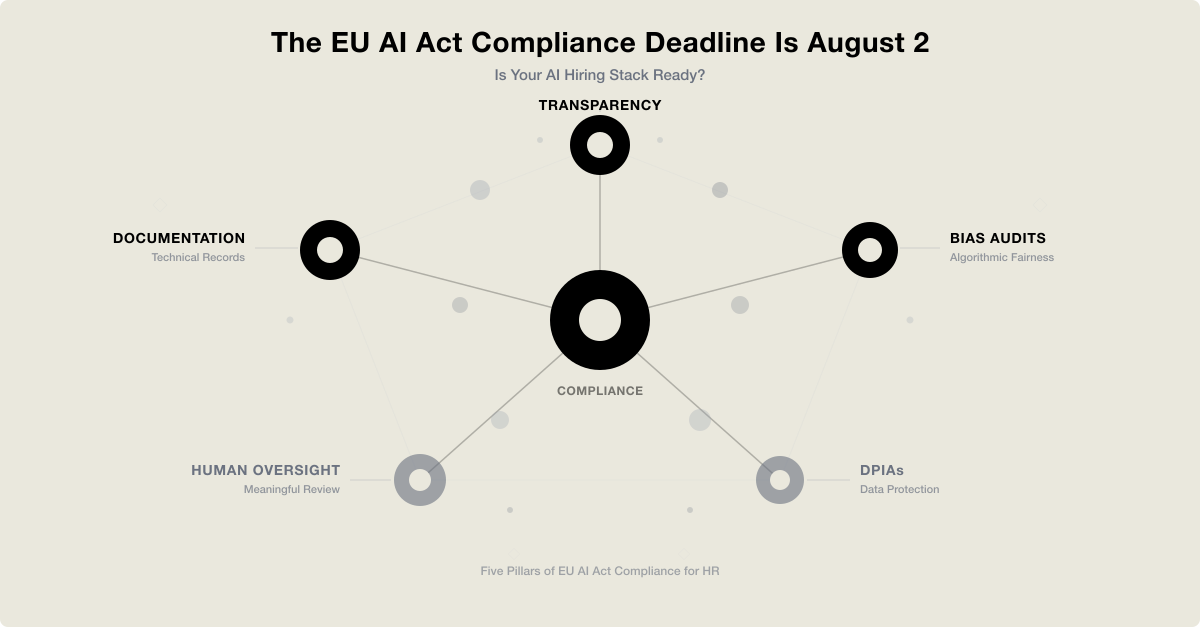
Let me break down the four pillars of EU AI Act compliance for hiring:
- Bias audits and algorithmic transparency. You need to demonstrate that your AI system doesn’t discriminate on protected grounds: gender, race, age, disability, sexual orientation, religion, whatever is legally protected in the EU. This isn’t a one-time checkbox. It’s ongoing. You conduct regular audits, document how you did them, and be prepared to show your work to regulators and lawyers alike.
- Technical documentation. The EU wants detailed documentation of how your system actually works. Training data, objectives, decision logic, edge cases, failure modes. You can’t just say “an AI model makes the decision.” You have to explain the model. Show the data. Document the assumptions baked into your system. This stuff has to be comprehensible, not buried in academic papers.
- Human oversight mechanisms. Here’s the thing: the regulation doesn’t allow fully autonomous hiring decisions. There has to be a human in the loop. Your AI Teammate can screen candidates, analyse résumés, surface the strongest prospects. But the final hiring decision, or at minimum, a meaningful review of the AI’s recommendation, has to involve a human decision-maker. That human needs the authority to override the AI and actually exercise that oversight.
- Data Protection Impact Assessments (DPIAs). Because AI hiring systems process personal data at scale, they trigger GDPR’s DPIA requirement. You assess the privacy risks, document how you mitigate them, and make sure the processing is proportionate and lawful.
Miss these four by August 2, and you’re looking at fines up to EUR 30 million or 6 per cent of annual global turnover, whichever is higher. More than that, you face reputational damage, litigation, and the very real possibility of having to tear out and rebuild your AI hiring systems mid-deployment.
That’s not a financial problem. That’s a business continuity problem.
The Uncomfortable Truth About Governance vs. Technology
Here’s what a lot of vendor conversations get wrong: they make EU AI Act compliance sound like a technology problem. You need the right AI system. You need the right audit tools. You need the right vendor.
It’s not. It’s a governance problem.
You absolutely need technology that can perform audits and generate documentation. But the real challenge is building an organisational culture and architecture where governance is baked in from day one, not bolted on after the fact. That’s the hard part.
This is why I think the FairNow heritage matters for Amp. Before the regulation even existed, the FairNow team was obsessed over fairness in AI hiring. They built tools to audit bias, explain decisions, and maintain human oversight. When Hg Capital’s Optro acquired FairNow in 2025, the mandate was clear: build an AI Teammates platform where trust, explainability, and governance are first principles, not afterthoughts.
That decision shapes everything about how Amp’s AI Teammates work. Every single one has built-in audit trails that track every decision, every reasoning step, every candidate interaction. You don’t retrofit logging. It’s native. Every AI Teammate operates within defined autonomy boundaries. You set the guardrails, the system respects them. An AI Teammate can screen a candidate, but it can’t unilaterally mark someone as rejected. Humans retain authority by design.
And explainability is native too. A candidate asks “Why wasn’t I selected?” Your AI Teammate explains it in plain language. A regulator asks “How did you make this decision?” You pull up the full decision tree, the data inputs, the logic, the human oversight that occurred.
This isn’t marketing language. This is architecture. It’s the difference between AI hiring systems that pass an EU AI Act audit on August 3 and those that are frantically trying to understand what “explainability” even means on August 1.
Why Working Across Systems Actually Matters for Compliance
I want to come back to this cross-system piece because it really matters.
Here’s what happens when your AI Teammates operate in isolation from your systems of record: compliance becomes exponentially harder. You’ve got candidate data in one place, AI decision-making in another, audit trails in a third. Everything’s disconnected. When regulators ask questions, you’re pulling data from multiple sources and hoping it tells a consistent story.
But when your AI Teammates work across Dayforce, iCIMS, UKG, Workday, SAP SuccessFactors, and Oracle HCM from day one? Everything flows through a single orchestration layer. Screening, interview scheduling, feedback collection, offer generation. It’s all in one place. One audit trail. Consistent data. You run a bias audit once across the entire hiring process.
Amp’s architecture is built for this because we know that real-world HR stacks are diverse. You’ve got Dayforce managing payroll and employee records in EMEA. You’ve got iCIMS running recruiting in North America. You’ve got UKG handling scheduling. You’re not choosing one system. That’s not how enterprise HR works. So our platform is designed to orchestrate agentic AI across that diversity without sacrificing governance or auditability.
What Agentic AI Actually Means (Because Everyone Defines It Differently)
The term “agentic AI” has gotten fuzzy. Some vendors use it to mean “any AI system with a user interface.” Others use it to mean “AI that takes actions without human approval.” We need precision here.
Agentic AI for HR is AI systems that perceive a hiring or talent workflow, reason about the next steps required, and autonomously take actions, subject to pre-defined guardrails and human oversight, to move that workflow forward. An agentic AI system for recruiting perceives that a candidate has applied. It reasons that the next step is screening against role requirements. It executes a screening assessment. It surfaces the results to a human recruiter for review and decision.
AI Teammates is how Amp refers to its agentic AI offering. These are designed for HR professionals. Not as replacements, but as autonomous agents that expand what a team can accomplish without expanding headcount. A recruiter works alongside an AI Teammate. A talent manager works alongside an AI Teammate. They handle the high-volume, repetitive work that slows down hiring. Humans handle the decisions that matter most.
Digital Labor for HR is the broader concept. It’s the idea that organisations can accomplish more work, serve candidates and employees better, and move faster by deploying intelligent systems that operate alongside human workers. It’s labour in the sense of getting work done at scale, not in the sense of replacing people.
Frequently Asked Questions
If our AI system is based in the US but our candidates are in Europe, does the EU AI Act apply?
Yes, absolutely. If you’re screening candidates in Germany, France, anywhere in the EU, the regulation applies to you. Geography of the vendor doesn’t matter. Where the candidate is matters.
What counts as “high-risk” AI under the EU AI Act?
Hiring and recruitment systems. Full stop. The EU recognises that biased hiring decisions cause real harm. They perpetuate discrimination, limit opportunity, compound historical inequities. That puts these systems in the high-risk category, which triggers governance, documentation, testing, and human oversight requirements.
We use a vendor’s AI screening tool. Who’s responsible for compliance: us or the vendor?
Both. The vendor is responsible for building a system that meets the technical and documentation requirements. You’re responsible for implementing it in a way that maintains human oversight, conducts ongoing monitoring, and ensures fair application. You can’t outsource compliance.
What does “human oversight” actually mean? Does every hiring decision need human review?
Meaningful human oversight means a human is in the loop and has the authority to understand, question, and override AI recommendations. You don’t manually review every decision. That defeats the purpose of automation. But you need systems that ensure humans can intervene meaningfully when needed. For screening, you might review top candidates and rejected candidates. For other decisions, the threshold might differ. The key is that it’s deliberate, documented, and auditable.
How often should we conduct bias audits?
The regulation doesn’t specify a fixed interval, but it requires ongoing monitoring and regular testing. Industry best practice is formal audits at least quarterly, with continuous monitoring in between. Hiring volumes and candidate demographics shift. Bias conditions change with them. Regular audits catch drift before it becomes a problem.
What should our bias audit measure?
Impact disparities across protected characteristics. If your system advances 80 per cent of male candidates but 60 per cent of female candidates to the next stage, that’s a red flag. Segment by role, geography, experience level, because bias hides in aggregates. An overall 70 per cent pass rate might mask 90 per cent for one group and 50 per cent for another.
We don’t have a technical team for DPIAs. What do we do?
A DPIA isn’t a technical document; it’s a governance document. It asks: What personal data does our system process? What risks do individuals face? How do we mitigate those risks? You may need external help (privacy lawyers, AI governance consultants), but you can draft a DPIA. Use templates as a starting point. Adapt them to your specific systems.
If we fail a bias audit, what happens?
It depends on severity. If you discover meaningful bias, your next steps are: (1) notify your data protection authority and counsel, (2) stop using the system or modify it to reduce bias, (3) remediate harm to affected candidates. Regulators prefer organisations that proactively discover bias, acknowledge it, and fix it over organisations they have to investigate. Transparency and corrective action matter.
Can AI Teammates from Amp help us meet these requirements?
Yes. They’re designed with EU AI Act compliance as a core principle. Built-in audit trails. Transparency features. Connection to your existing HR systems so all candidate data and decision logic flow through a unified, auditable orchestration layer. That said, no AI system solves compliance on its own. You still need strong governance processes, regular audits, human oversight protocols, legal review. Amp’s the foundation. Compliance is an organisational commitment.
Compliance as Competitive Advantage
Here’s what most organisations get wrong about EU AI Act compliance: they treat it like a cost centre. A regulatory requirement to meet with minimum effort so they can move on to other priorities. That framing is backwards.
Organisations that treat compliance as a design principle, not a checkbox, build AI hiring systems that are not only legally safe but also more effective.
Why? Because the mechanisms that drive compliance (explainability, fairness testing, human oversight) also drive better hiring outcomes. When you know how your AI system makes decisions, you improve those decisions. When you test for bias, you eliminate hiring friction that slows down your best candidates. When you maintain human oversight, you preserve organisational knowledge and judgement that no AI system can replicate.
The organisations that will win in the agentic AI era aren’t the ones that deploy AI first. They’re the ones that deploy AI well: with trust, with governance, with explainability, with fairness as a first principle, not an afterthought.
August 2 isn’t a burden. It’s an opportunity to get this right from the start.
We built Amp to deliver enterprise-grade governance across your full HR stack. Audit trails, autonomy boundaries, and explainability are baked into every AI Teammate, working across Dayforce, iCIMS, UKG, Workday, SAP SuccessFactors, and Oracle HCM. If you’d like to see how that works inside the systems you already run, we’d welcome the conversation.