
The Recruiting Bottleneck Nobody Wants to Admit
High-volume recruiting is broken. Not in a way that HR leaders talk about openly, but in the way that keeps them awake at night. A mid-market company receives ten thousand applications per quarter. An enterprise organisation processes thirty thousand. Yet the infrastructure built to handle candidate flow has remained largely unchanged for a decade: a primary applicant tracking system, bolted on hiring managers doing the screening, scheduling scattered across email and calendar invitations, and handoffs between disconnected systems that lose candidate context at every step.
I saw this problem firsthand at Ideal, the talent intelligence platform I founded before its acquisition by Dayforce. We worked with many talent acquisition teams who faced the same structural constraint. The bottleneck was not technology capability; it was that no single tool owned the entire recruiting workflow. The ATS managed candidate data. The HRIS held employee records. The scheduling system lived in a separate domain. Communication platforms operated in isolation. Each system worked well in isolation, but together they created a fragmented journey where candidates fell through cracks and hiring managers spent half their time context-switching rather than evaluating talent.
The promise of agentic AI for recruiting is to solve this problem at scale. Yet most of the solutions being sold today are not solving it; they are merely relocating the bottleneck.
Why Chatbots and Copilots Fall Short
A recruiting chatbot is fundamentally a supervised tool. It can draft an email, summarise a resume, or suggest screening questions. It sits inside a single application, typically the ATS, and it requires human judgment before any action proceeds. The chatbot does not own the outcome. It assists a person who owns the outcome, and that person must review, approve, and execute every step.
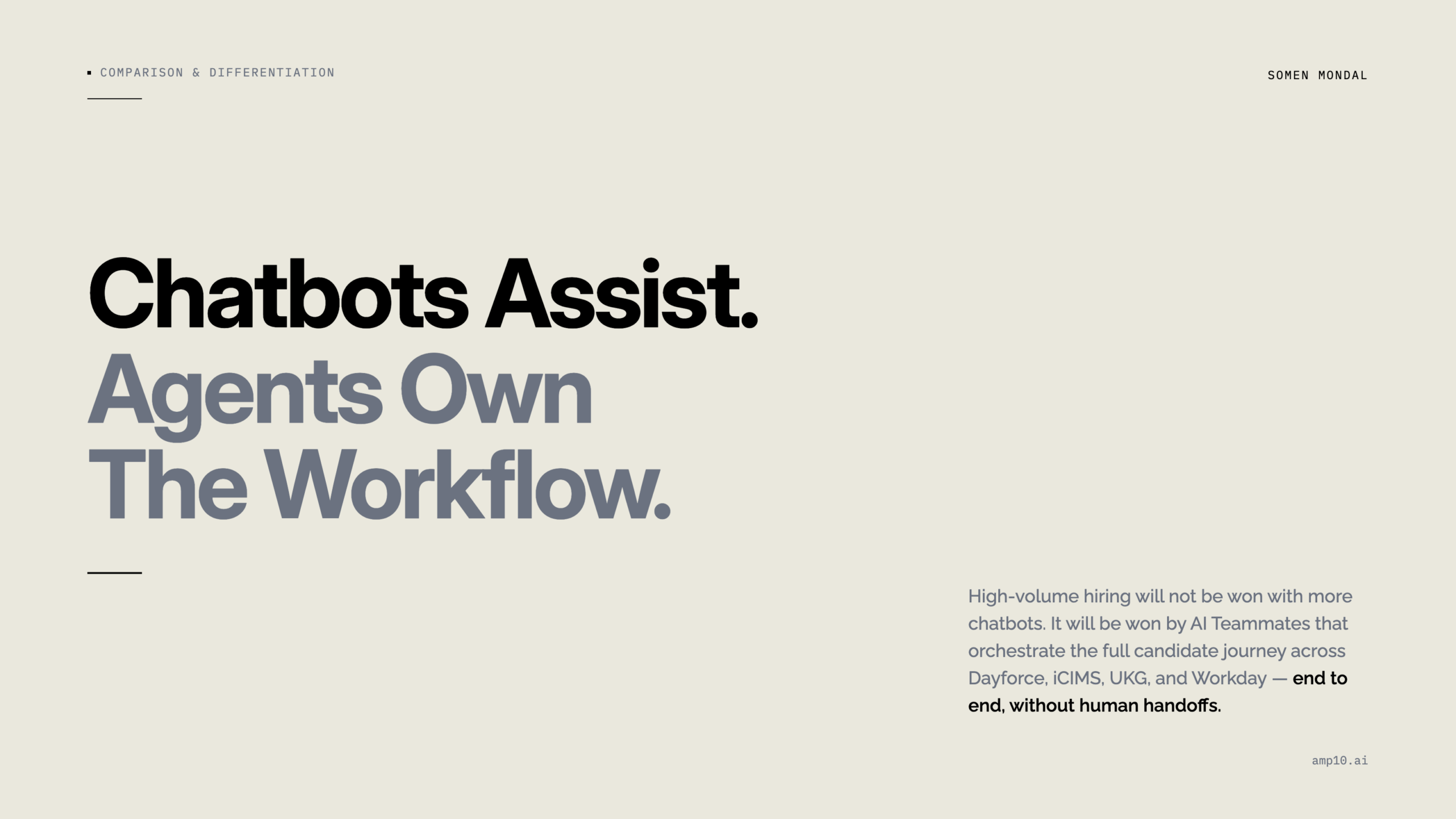
This distinction matters more than it might initially appear. Agentic AI for recruiting is not simply a smarter chatbot. It is a system that can orchestrate decisions and actions across the entire recruiting workflow without human intermediation at each step. It screens candidates against hiring criteria, reserves time on a hiring manager’s calendar, sends scheduling invitations to candidates, collects feedback from interviewers, and feeds results back into the ATS, all with appropriate governance guardrails and audit trails.
A chatbot inside an ATS can offer suggestions. It cannot schedule a candidate interview across three hiring managers, check their availability in the corporate calendar system, confirm acceptance with the candidate via email, and then update both the ATS and the HRIS with the interview result. It cannot do this because it is confined to one system. It cannot see the availability of the hiring manager’s calendar. It cannot write to the email system. It cannot trigger the onboarding workflow when an offer is accepted.
The result is that a chatbot reduces friction within its single domain but does not solve the fundamental coordination problem. Recruiting leaders still need people to execute the cross-system workflows. The chatbot has made those people more efficient, but it has not scaled the workflow itself.
The Cross-SOR Advantage: Orchestrating the Full Candidate Journey
Recruiting workflows do not live in a single system. They span a constellation of systems: the ATS, the HRIS, the scheduling system, the email platform, the assessment tool, and the onboarding system. These are sometimes called systems of record, or SORs.
The competitive advantage of agentic AI for recruiting is not capability within a single system; it is capability across systems. An AI Teammate that works across Dayforce, iCIMS, UKG, Workday, and other recruiting and HR platforms can orchestrate the full candidate journey from application through onboarding. It can see candidate records in the ATS, check hiring manager availability in the calendar, coordinate scheduling across systems, and update downstream workflows with the results.
This is where Amp’s approach differs fundamentally from the SOR vendors themselves. Dayforce, UKG, Workday, and other recruiting platform leaders have invested deeply in agentic AI capabilities within their own systems. These investments are valuable and should continue. But their agentic AI operates within the boundary of their platform. It cannot orchestrate actions in a competing ATS or HRIS. It cannot see your calendar system. It cannot send emails through your corporate email platform on your behalf.
Amp sits on top of this SOR ecosystem. Our AI Teammates are built from the ground up to work across systems. We integrate with Dayforce, iCIMS, UKG, Workday, and others, treating each as a peer data source and execution platform. This means that organisations with heterogeneous recruiting stacks, which is to say most large organisations, can deploy agentic AI that actually owns the full recruiting workflow, not just one piece of it.
What Agentic AI for Recruiting Actually Looks Like
Consider a concrete example of how cross-SOR agentic AI for recruiting works in practice. A company receives two hundred applications for a customer success manager role. A traditional recruiting workflow would require a TA team member to review each application against the job criteria, manually check the calendar availability of the hiring manager, send scheduling emails, and wait for responses.
An AI Teammate works across this entire flow. It ingests the job description and screening criteria from the ATS. It retrieves the hiring manager’s availability from the calendar system. It evaluates each of the two hundred applications against the criteria, ranking candidates by fit. For the top candidates, it automatically reserves time on the hiring manager’s calendar, sends a scheduling invitation to the candidate with context about the role and the interview process, and documents the action in the ATS with timestamps and reasoning.
When the hiring manager completes the interview, feedback is captured in the ATS. The AI Teammate reads that feedback, evaluates whether the candidate advances to the next round, and if so, it coordinates with the scheduling system to book the next interview. If a candidate receives an offer and accepts, the AI Teammate triggers the onboarding workflow in the HRIS, ensuring that all downstream systems are synchronized.
Throughout this process, every action is auditable. The system maintains a log of decisions, the criteria used to make them, and the workflows triggered. A compliance officer can trace why a candidate advanced or was rejected. A hiring manager can understand the reasoning behind a scheduling recommendation. An HR leader can see which workflows the AI Teammate executed and which required human intervention.
This is what agentic AI for recruiting means in practice: systems that can own recruiting outcomes across the full candidate journey, not because they are smarter chatbots, but because they have been designed from the ground up to orchestrate workflows across the tools that recruiting teams already use.
Buying Criteria for Recruiting Leaders
If your organisation is evaluating agentic AI for recruiting, there are several dimensions on which solutions differ significantly. Most of these differences are invisible in marketing materials, and many recruiting leaders do not think to ask about them until they are deep in a pilot.
The first criterion is cross-system capability. Does the solution work within a single ATS or HRIS, or does it orchestrate across systems? If it is confined to one platform, it is a point solution, not a workflow platform. Ask for a specific example of a workflow that spans multiple systems that the solution can own end-to-end without human intermediation.
The second criterion is governance. Every recruiting action carries compliance risk. An AI system that screens candidates must be able to provide transparent reasoning about its decisions. It must maintain audit trails. It must have guardrails to prevent bias and discrimination. These are not nice-to-have features; they are essential to responsible deployment. Ask whether the solution can explain its screening decisions, how it logs actions, and what safeguards exist around sensitive recruiting decisions.
The third criterion is consumption-based pricing. Recruiting workflow volume is variable and seasonal. In August, you might process one thousand applications. In January, you might process ten thousand. A pricing model that charges per seat creates perverse incentives: organisations either overpay for seasons of light volume or underpay and overload a fixed set of users. Consumption-based pricing aligns cost with volume. You pay for what you use.
The fourth criterion is integration breadth. No two recruiting stacks are identical. Your organisation might use Dayforce as your HRIS and iCIMS as your ATS, while another organisation uses Workday and UKG. The solution must integrate with your actual tools, not a hypothetical configuration that matches the vendor’s preferred stack.
The Path Forward: Digital Labor for HR at Scale
The term agentic AI for recruiting is still new, and many recruiting leaders conflate it with chatbots and copilots they already use. The distinction is important. Chatbots assist humans within a single system. Agentic AI for recruiting owns workflows across systems.
This distinction will matter increasingly as recruiting volume grows and the talent market becomes more competitive. Organisations that can process ten thousand applications without proportionally adding TA headcount will have a significant advantage. Organisations that are hiring across multiple geographies, technical disciplines, and seniority levels simultaneously will be able to optimise each funnel independently. Organisations that can reduce time-to-hire because scheduling and handoffs are automated will be able to move faster than competitors.
Amp’s thesis is captured in our tagline: Scale HR and Talent Without Scaling Headcount. We believe that organisations should not need to add three more TA team members to double their hiring volume. Cross-SOR agentic AI makes this possible.
If you are evaluating solutions in this category, focus on the four buying criteria outlined above: cross-system orchestration, governance, consumption pricing, and integration breadth. Dismiss solutions that are confined to a single platform. Ask hard questions about audit trails and decision reasoning. Understand your actual recruiting volume pattern and whether the pricing model aligns with it.
The future of recruiting is not more chatbots. It is autonomous systems that orchestrate the full candidate journey across the tools you already use, with governance and transparency built in from the start.
If You Are Evaluating Agentic AI for Recruiting
The organisations that will win the high-volume hiring race are those that deploy agentic AI across their full recruiting stack, not within a single platform. If you are building your agentic AI strategy this year and want to see how AI Teammates orchestrate the full candidate journey across Dayforce, iCIMS, UKG, and Workday, we would welcome the conversation.
Frequently Asked Questions
What is agentic AI for recruiting?
Agentic AI for recruiting refers to autonomous systems that can own and execute recruiting workflows without human intermediation at each step. Unlike chatbots or copilots that assist humans within a single application, agentic AI for recruiting orchestrates decisions and actions across multiple recruiting systems, including the ATS, HRIS, calendar systems, email platforms, and assessment tools. It can screen candidates, schedule interviews, coordinate across hiring managers, collect feedback, and update downstream systems, all with appropriate governance guardrails and audit trails.
How is agentic AI different from recruiting chatbots?
Recruiting chatbots are supervised tools that assist humans within a single system. They might draft an email, summarise a resume, or suggest screening questions, but a human must review and approve every action before it proceeds. Chatbots do not own recruiting outcomes; they help humans who own them. Agentic AI for recruiting, by contrast, is designed to own workflows. It can make decisions within defined criteria, execute actions across systems, and operate autonomously with appropriate oversight. A recruiting chatbot might suggest which candidates to interview; agentic AI for recruiting will schedule those interviews across the hiring manager’s calendar, email the candidates, and update the ATS with the result.
Can AI Teammates work across multiple ATS and HRIS platforms?
Yes. The core design principle of cross-SOR agentic AI is that it integrates with multiple systems and treats them as peer data sources and execution platforms. An AI Teammate can read candidate records from your ATS, check hiring manager availability in your calendar system, write scheduling confirmations to your email platform, and update your HRIS with interview results. This cross-system capability is essential for organisations with heterogeneous recruiting stacks, which is the norm in large enterprises.
What is cross-SOR orchestration in recruiting?
Cross-SOR orchestration refers to the ability to coordinate workflows across multiple systems of record. In recruiting, this means that an AI system can see data from your ATS, HRIS, calendar, email, and assessment tools, and can execute actions in all of them as part of a single workflow. For example, a cross-SOR orchestration system can screen candidates in the ATS, check hiring manager availability in the calendar, send a scheduling email to the candidate, and update the HRIS with interview notes, all as part of one coordinated workflow without requiring human handoffs between systems.
How do AI Teammates handle candidate screening?
AI Teammates screen candidates by ingesting the job description and screening criteria from the ATS, then evaluating each application against those criteria. The screening process is transparent: the system documents the criteria it applied, the candidate’s qualifications, and the reasoning for advancement or rejection. This transparency is essential for compliance and governance. Screening decisions can be audited, and the reasoning is logged so that compliance teams can verify that decisions are defensible and not biased.
Is agentic AI for recruiting compliant and auditable?
Responsible agentic AI for recruiting must have governance and auditability built in from the start. Every recruiting decision carries compliance risk around discrimination and bias. A robust agentic AI system maintains audit trails of all decisions, documents the criteria and reasoning applied to each candidate, provides transparency into its decision logic, and has safeguards to prevent bias. These are not optional features; they are essential to responsible deployment at scale.
What should TA leaders look for when evaluating agentic AI?
When evaluating agentic AI for recruiting, focus on four key dimensions. First, cross-system orchestration: does the solution work across your actual recruiting stack, or is it confined to a single platform? Second, governance: can the system explain its decisions, maintain audit trails, and operate with appropriate safeguards? Third, consumption-based pricing: does the cost model align with your actual recruiting volume, or does it create perverse incentives? Fourth, integration breadth: does the solution integrate with the specific systems your organisation uses, or does it assume a particular vendor stack?
How does consumption-based pricing work for recruiting AI?
Consumption-based pricing for recruiting AI charges based on the volume of actions executed or workflows run, rather than per seat or per user. This model aligns cost with actual usage, which varies seasonally and by hiring intensity. In heavy hiring seasons, you pay more because you use the system more. In light seasons, you pay less. This is more equitable than seat-based pricing, which forces organisations to either overpay for seasons of light volume or underpay and overload a fixed set of users. Consumption pricing scales with your business without creating fixed cost obligations that do not align with actual volume.