The HR Operations Reality
Talented HR professionals in enterprise organizations are consistently buried in transactional work. The systems of record manage employee data brilliantly, but the execution of day-to-day operations still falls on people. An employee changes their address. Compliance requires documentation. A benefits question comes in. A policy needs enforcing. Each task requires multiple steps across multiple systems. The volume is relentless, and it scales with headcount. Exceptional HR leaders spend more time executing routine workflows than on strategic work that only humans can do. That is the gap that agentic AI for HR operations is built to fill.
The problem is not that HR technology lacks sophistication. The challenge is that most HR solutions focus on managing information rather than executing operational work. A system of record excels at storing data, but the translation of that data into autonomous action has remained incomplete. Traditional automation can handle the expected path, but the moment a variable changes or an exception emerges, a human has to step in. The volume of exceptions in HR operations is far greater than most organizations anticipate.
This guide explores how autonomous AI systems are beginning to fill this execution gap. It is structured for HR operations leaders evaluating agentic AI, procurement teams assessing vendor capabilities, and technology teams planning implementation roadmaps.
What Is Agentic AI for HR Operations?
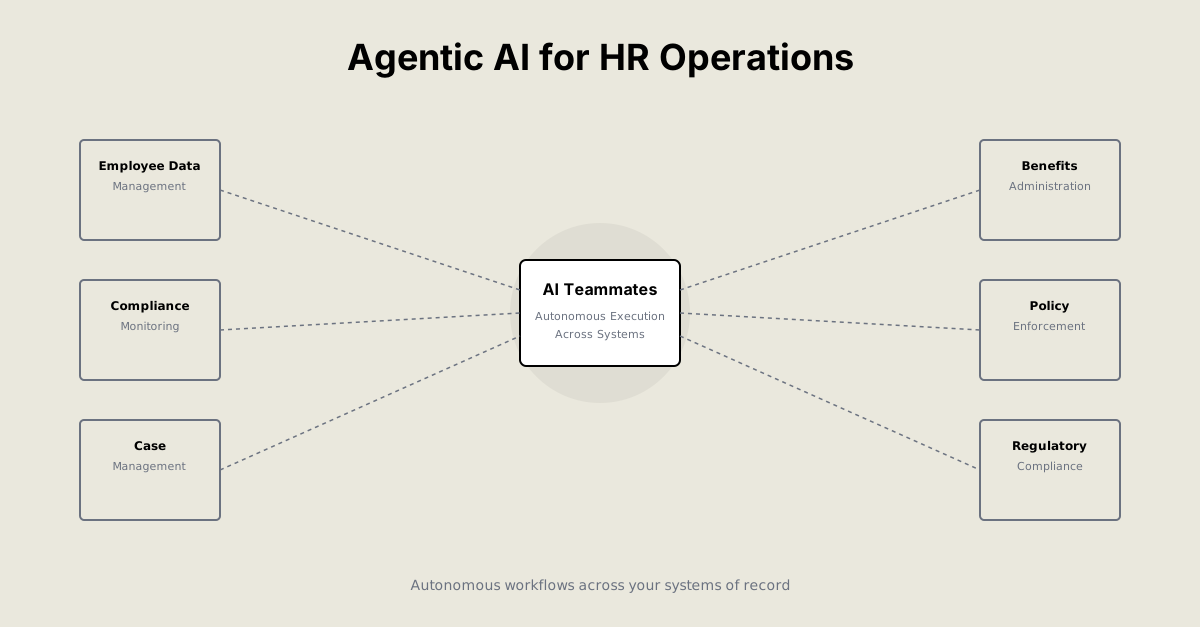
Agentic AI for HR operations comprises autonomous AI systems that execute day-to-day HR operational workflows end to end. These systems manage employee data changes, resolve HR cases, monitor regulatory requirements, administer benefits programmes, and enforce policy consistently across the organization. Unlike systems that suggest actions or follow rigid rules, agentic AI reasons through complexity, makes decisions within defined guardrails, and completes workflows without human intervention at each step.
The defining characteristic is autonomy. An AI Teammate does not suggest that a compliance document be filed; it files the document, verifies the filing, logs the action, and alerts the relevant stakeholder if an issue arises. An AI Teammate does not recommend that an employee case be routed; it evaluates the case, determines the appropriate routing path, tracks the resolution, and escalates if circumstances change.
This distinction matters because HR operations are full of decision points that require reasoning rather than rigid rule-following. A policy question from an employee rarely has a simple yes or no answer. An address update for an employee based in a new jurisdiction may trigger compliance obligations specific to that location. A case involving multiple policies may require balancing competing requirements. Agentic AI navigates these complexities whereas traditional automation cannot.
The HR Operations Bottleneck
The typical HR operations team manages a portfolio of workflows that includes employee data management, case resolution, compliance monitoring, benefits administration, and policy questions. Each workflow generates volume that scales with headcount. An organization with two thousand employees may process dozens of address changes, role transitions, and compensation adjustments each month. Compliance requirements across multiple jurisdictions generate constant monitoring obligations. Benefits open enrollments create temporary spikes in volume that can strain small operations teams.
The challenge is not that individual tasks are complex. The challenge is the volume, the number of systems involved, and the exceptions that exist within the expected flow. A policy question might seem straightforward until the employee circumstances do not match the standard interpretation. A data change might appear routine until it triggers a compliance obligation in a specific jurisdiction. A case might seem simple until it involves multiple policies or stakeholders.
Traditional HR automation, including robotic process automation and workflow tools, handles the predictable path efficiently. These systems excel when the rules are clear, the data is consistent, and the outcome is deterministic. The moment a variable changes or an exception emerges, the workflow pauses and a human takes over. In HR operations, exceptions are frequent. An employee might request a data change that contradicts existing policy. A compliance obligation might overlap with another requirement. A case might involve an employee in a special circumstance that does not fit the standard process.
The result is that HR operations teams spend significant time on exception handling. They build sophisticated rules to try to anticipate edge cases, but they cannot anticipate every variation. They create manual workarounds for common exceptions, but the list of exceptions never stops growing. This is where agentic AI is fundamentally different.
What AI Teammates Do in HR Operations
AI Teammates handle five core operational workflow categories in HR. Understanding what they do requires examining each category in detail rather than accepting high-level generalisation.
In employee data management, AI Teammates process employee changes across systems of record without human intervention. An employee submits an address change. The AI Teammate receives the request, validates the address, checks whether the new location triggers any compliance obligations, updates the address in the core system, notifies any subsidiary systems that require the change, logs the action with a timestamp and change record, and alerts the employee that the change is complete. This same autonomous execution applies to role changes, compensation adjustments, reporting line changes, and other personnel updates. The volume that typically requires manual processing can instead be executed autonomously with full audit trails and verification.
In HR case management, AI Teammates triage and resolve employee inquiries at scale. An employee submits a question about policy, a request for an exception, or a concern about their employment situation. The AI Teammate receives the inquiry, classifies it according to its nature and complexity, determines whether it can be resolved autonomously or whether it requires human judgment, routes complex cases to the appropriate HR professional with full context, tracks the case through resolution, and notifies the employee when the case is closed. Cases that require a human decision get to the right person with complete information rather than languishing in a queue. Routine inquiries are resolved instantly. The net effect is faster resolution and better case visibility.
In compliance workflows, AI Teammates monitor regulatory requirements and execute required documentation. Different jurisdictions impose different requirements around leave, compensation, notice periods, and documentation. An AI Teammate monitors an organization’s employee roster against these requirements, identifies any non-compliance, generates required documentation, executes filings where possible, and alerts leadership to obligations that require human decision-making. The compliance team moves from reactive response when an audit occurs to proactive management of obligations throughout the year.
In benefits administration, AI Teammates process enrollment changes, answer policy questions with accurate information, and coordinate with benefits providers. An employee requests a benefits change. The AI Teammate verifies the request against policy, validates that the requested change is permitted, processes the change in the benefits system, coordinates with the carrier if necessary, confirms the change with the employee, and documents the action. Benefits questions from employees are answered with policy-accurate responses rather than general information. The benefits team handles exceptions and policy exceptions rather than routine transaction processing.
In policy enforcement, AI Teammates apply consistent policy interpretation across the organization and escalate edge cases to HR leadership. Policy interpretation varies dramatically across large organizations because different people apply policy differently. An AI Teammate learns the organization’s policy framework, applies it consistently to recurring situations, and escalates situations that do not fit the standard interpretation to an HR leader for a decision. Over time, this creates a foundation of consistent precedent and reduces the number of ad hoc decisions.
Why Traditional HR Automation Falls Short
The constraints of traditional automation become apparent in HR operations because HR work is full of exceptions. Robotic process automation follows predetermined rules and executes them consistently. When the conditions match the rule, RPA executes perfectly. When the conditions change or an exception emerges, the process breaks and a human has to intervene. The problem is that HR operations is constructed of exceptions layered on top of exceptions. A policy applies to most employees but not to unionized employees. A compliance requirement applies to full-time employees but not to contractors. A process works in one jurisdiction but not in another. RPA cannot navigate this landscape without building rules for every possible exception, which becomes unmaintainable.
Copilot systems present a different set of constraints. Copilots suggest actions to humans, but humans still execute the actions. An HR professional receives a suggestion to process an employee data change, but the human still needs to log into the system, verify the information, make the change, and document the action. The human attention requirement remains even though the cognitive work is reduced. Copilots accelerate human work; they do not remove the human from the workflow.
Agentic AI is fundamentally different because it completes workflows autonomously within defined guardrails. An AI Teammate does not suggest; it executes. An AI Teammate does not require a human at each step; it works until it reaches a decision point that requires human judgment, and only then does it escalate. This is possible because modern large language models can reason through complexity, recognize edge cases, and make decisions based on context rather than rigid rules. An AI Teammate can read a policy, understand its intent, apply it to a novel situation, and either execute the decision or escalate if the situation is outside its defined authority.
The distinction matters at scale. A 50-person HR operations team handling a thousand employees might process thirty employee data changes in a month, answer fifty policy questions, resolve forty cases, and manage compliance for five jurisdictions. Doubling to two thousand employees does not double the work; it can triple or quadruple it because the number of exceptions scales with headcount. Agentic AI is the only approach that scales linearly with headcount rather than exponentially.
The Cross-System Challenge in HR Operations
Most enterprises run multiple systems to execute HR operations. A typical portfolio includes a core human capital management system, a payroll system, a benefits system, a time and attendance system, and a case management system. Some organizations also run dedicated systems for learning, performance management, or compensation planning. Each system is a system of record for its domain. Each system generates data that other systems consume.
The problem is that most AI capabilities are bound to individual systems. A vendor’s AI capability operates only within that vendor’s platform. Dayforce has AI capabilities within Dayforce. UKG has AI capabilities within UKG. Workday has AI capabilities within Workday. This creates an architectural limitation because HR operations workflows often span systems. An employee data change made in the core HCM system needs to flow to payroll, benefits, time and attendance, and potentially to subsidiary systems. A case resolution might require updates across multiple systems. A compliance obligation might be triggered by data in one system and require documentation in another.
An HR operations team building AI capabilities needs to either build integration logic between multiple vendor AI systems, or accept that each system can only automate within its own boundaries. Neither option is satisfactory. Building integration between vendor systems is complex, fragile, and creates ongoing maintenance burden. Accepting system boundaries means that AI cannot execute end-to-end workflows because those workflows cross system boundaries.
This is where AI Teammates differ because they operate as a unified execution layer across systems. An AI Teammate connects to Dayforce, iCIMS, UKG, Workday, and other major systems through integration layers. When an AI Teammate executes a workflow that spans systems, it orchestrates actions across all connected systems as a single logical operation. An employee data change flows from core HCM to payroll to benefits as a coordinated set of actions rather than as separate operations in each system. This cross-system capability is essential for HR operations at scale.
Governance and Trust in HR Operations
HR operations involve sensitive employee data, regulated processes, and decisions that affect people’s livelihoods. Autonomous AI cannot operate without governance infrastructure that ensures decisions are lawful, fair, and aligned with the organization’s values.
This is not an optional layer built after the fact. Governance must be embedded from the beginning. An AI Teammate operating in HR must have access controls that limit what it can do based on role and jurisdiction. It must have audit trails that log every decision and every action. It must have escalation rules that ensure humans make decisions in areas where human judgment is required. It must have explainability that allows someone to understand why it made a decision and how it applied policy.
Amp’s AI Teammates are built on the FairNow foundation. Amp’s founding team spent three years building AI governance infrastructure specifically for enterprise HR through FairNow, prior to founding Amp. FairNow addressed policy alignment, where the AI system learns the organization’s specific policies and applies them consistently. It addressed access control, where the AI system respects role-based permissions and jurisdiction-based restrictions. It addressed auditability, where every decision is logged with the context, the reasoning, and the outcome. It addressed explainability, where a human can review a decision and understand how the AI Teammate arrived at that conclusion.
This governance foundation is not incidental. It is the primary differentiator between AI that can operate in regulated enterprise HR and AI that can only operate in less sensitive contexts. An organization considering agentic AI for HR operations should evaluate governance as a primary criterion, not a secondary feature.
The Digital Labor Model for HR Operations
Agentic AI for HR operations introduces a different economic model compared to traditional licensing. Instead of purchasing seats or paying per-user fees, organizations purchase Digital Labor, which is capacity measured by work done rather than seats licensed. Digital Labor appears as a line item on the HR budget, similar to how outsourced services appear. The cost is calculated based on how much work the AI Teammates do, how complex that work is, and how many systems they operate across.
This consumption-based pricing model aligns cost with value delivered. An organization that adds five hundred employees and proportionally increases HR operations work can expand AI Teammate capacity without purchasing additional licenses or renegotiating contracts. An organization that reduces reliance on certain HR workflows can reduce consumption without losing access to AI capabilities. The cost structure is transparent and scales with the work actually performed.
Digital Labor operates under a licensing model, meaning the organization retains data ownership and control. The AI Teammates operate within the organization’s systems using the organization’s data. The work is performed according to the organization’s policies and within the organization’s governance frameworks. This differs fundamentally from outsourced services where work is performed by a third party.
Evaluating Agentic AI for HR Operations
An HR operations leader evaluating agentic AI should develop an evaluation framework focused on operational reality rather than vendor claims. The following criteria matter most.
First, does it handle exceptions or only the expected path? Vendor demonstrations typically show ideal workflows where all data is correct, policies are clear, and no complications arise. Real HR operations are full of exceptions. Can the AI Teammate handle an address change for an employee in a jurisdiction it has not encountered before? Can it resolve a case involving multiple conflicting policies? Can it escalate when it reaches a situation outside its authority? If it can only execute in ideal conditions, it will not handle the real volume in your operations team.
Second, does it work across your systems or only within a single platform? If the organization uses Dayforce for core HR, UKG for payroll, and a separate benefits platform, can the AI Teammate execute workflows that span all three? If it can only work within one system, it cannot automate the most valuable workflows because those workflows cross systems.
Third, does it come with governance built in or does governance require custom development? Governance should be part of the product architecture, not an afterthought. The AI Teammate should have role-based access controls, audit trails, escalation rules, and explainability built into its core operation.
Fourth, can it operate within your existing access controls and audit policies? Your organization has established how employees can access systems, what data is visible to whom, and how changes are logged. An AI Teammate must respect those controls rather than requiring new access models.
Fifth, what is the implementation timeline and what level of integration is required? Evaluating claims about speed requires understanding what speed actually means. Does it mean speed to first deployment, or speed to autonomous execution of complex workflows? Most AI solutions offer fast initial deployment followed by months of customization and tuning. How many hours of professional services integration are required, and what happens when you need to add new workflows or modify existing ones?
Frequently Asked Questions
What is agentic AI for HR operations?
Agentic AI for HR operations comprises autonomous AI systems that execute end-to-end HR operational workflows. These systems manage employee data changes, resolve HR cases, monitor compliance requirements, administer benefits programmes, and enforce policy consistently across the organization without human intervention at each step.
How do AI Teammates differ from HR automation or RPA?
HR automation and robotic process automation follow rigid rules and break when variables change. Copilots suggest actions but humans still execute them. AI Teammates reason through complexity, make decisions within defined guardrails, and complete workflows autonomously. This enables them to handle exceptions that traditional automation cannot.
Can AI Teammates handle HR case management autonomously?
Yes. AI Teammates can receive an employee inquiry, classify it by type and complexity, determine whether it can be resolved autonomously based on policy and context, route cases that require human judgment to the appropriate HR professional with full context, track the case through resolution, and notify the employee when complete.
How do AI Teammates work across multiple HR systems?
AI Teammates operate as a unified execution layer across systems of record. They connect to major systems including Dayforce, iCIMS, UKG, Workday, and other enterprise platforms. When a workflow spans systems, the AI Teammate orchestrates actions across all connected systems as a single logical operation rather than as separate operations within each system.
What HR compliance workflows can AI Teammates execute?
AI Teammates monitor regulatory requirements across jurisdictions, identify non-compliance against rules you define, generate required compliance documentation, execute filings where permitted by policy, and alert leadership to obligations requiring human decision-making. This enables proactive compliance management rather than reactive response when issues are discovered.
Do AI Teammates replace HR operations staff?
No. AI Teammates handle transactional and routine operational workflows, allowing HR operations staff to focus on strategic work, complex case resolution, and policy decisions. The role of HR operations professionals shifts from execution to oversight and judgment, where human expertise creates most value.
How is governance handled for autonomous AI in HR operations?
Governance is built into the AI Teammate architecture rather than added as an afterthought. This includes role-based access controls that respect the existing access model, comprehensive audit trails that log every decision and action, escalation rules that ensure humans make decisions requiring judgment, and explainability that shows how the AI Teammate arrived at a decision.
What does consumption-based pricing mean for HR operations AI?
Instead of purchasing seats, organizations purchase Digital Labor measured by work done. Cost scales with the volume of work the AI Teammates execute and the complexity of that work. This aligns cost with value delivered and allows organizations to expand or reduce capacity without renegotiating licensing terms.
Implementation Roadmap
A typical AI Teammates implementation in HR operations begins with integration and governance baseline. The organization defines the AI Teammate’s access to systems, the policies it will enforce, and the escalation rules that determine when a human decision is required. This phase typically requires four to eight weeks, depending on system complexity and governance maturity.
The second phase focuses on initial workflow deployment. Most organizations begin with employee data management and benefits administration because these workflows have clear rules and high transaction volume. Early wins build internal confidence and provide operational data that informs the next phase.
The third phase expands to case management and compliance workflows. These workflows are more complex because they involve policy interpretation and exception handling. By this stage, the AI Teammate has sufficient context about the organization’s policies and decision patterns to operate in these domains.
Throughout implementation, the focus is on creating a feedback loop where the organization provides guidance on policy and decisions, the AI Teammate learns from that guidance, and gradually operates with less oversight as it demonstrates reliable judgment.
Next Steps
Agentic AI for HR operations is beginning to move from promising concept to operational reality in organizations that have built proper governance infrastructure and made integration across systems central to their architecture. The constraint on adoption is not the existence of technology, but the willingness to invest in governance and integration work upfront rather than trying to retrofit it later.
If your HR operations team is managing high transaction volume, handling frequent exceptions, struggling with cross-system coordination, or facing compliance challenges that require constant oversight, agentic AI is worth evaluating in your specific context.
Related Resources
Explore how agentic AI is transforming other areas of HR: